We may receive a commission when you use our affiliate links. However, this does not impact our recommendations.

Ever since we published plans for the Holtzapffel Cabinetmaker’s Workbench in Issue 8 of Woodworking Magazine, readers have requested information on how to build the bench so it could be easily knocked down and moved.
The version I built and published plans for in Issue 8 used old-world bench-building principles where the legs were tenoned into the top and the base parts were permanently drawbored. But when Kelly Mehler and I taught a class in constructing the bench last month, we decided to modify the plans to make the whole thing break down for easy transport. The students hailed from all over the country (Missouri, Alaska, Michigan), and so a portable version was necessary.
By the way, if you missed my daily blog posts about this class, you can find them over at the Popular Woodworking editor’s blog by clicking below.
Day 1: Sticks
Day 2: Glue
Day 3: Grit
Day 4: Gruntwork
Day 5: Grease
Day 6: Guessing
Day 7: Gone
This weekend my blisters from the class began to fade, and so I cleaned up the construction drawing and cutting list a bit , you can download them for free below.
Here’s how the knockdown construction works in a nutshell: The workbench’s base is made up of two end assemblies, which are permanently glued and drawbored, plus two long stretchers.
Compared to the original design, the only changes to the end assemblies are that the legs don’t have tenons on the top and you need to add a 3″-wide top stretcher to each end assembly. These top stretchers will help you attach the base to the benchtop.
The base’s long stretchers are significantly different. The long stretchers have short tenons and are attached to the end assemblies with 1/2″ x 8″-long hex-head cap screws, washers and nuts. All in all, the base’s joinery works a lot like a traditional bed.

The assembled joint that shows the cap screws in place and the plywood template.

The disassembled joint that shows the short tenon on the long stretcher.
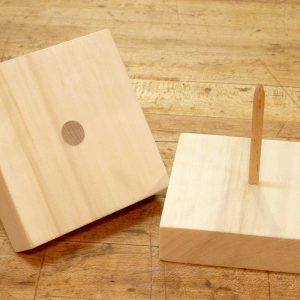
To install the cap screws, drill 5/8″-diameter holes through the legs. Then rout out slots for the nuts and washers in the long stretchers using a plywood pattern, a 1/2″ spiral bit and a guide bushing (see the photo for what this looks like). With the slots routed, install the cap screws, washers and nuts. Snug everything up with a socket set and box wrench.
With the base assembled, attach the workbench’s top to the base with 3/8″ x 5″-long lag screws through the top stretchers in the end assemblies. We used four lag screws per bench. The screws at the front of the bench were in 3/8″-diameter holes. The screws at the rear of the bench were in 1/2″-diameter holes, which allows for wood movement.
Everything else about this bench is identical to the plans found in Issue 8.