We may receive a commission when you use our affiliate links. However, this does not impact our recommendations.
 Most of my projects have some form of dovetail joinery. Drawers have half-blind and through-dovetails joints, and drawer dividers generally attach to the case with sliding dovetails. In fact, other than the Southern Gent’s Mirror Stand from the August 2013 issue (#205), I cannot remember the last project to come out of my shop in which no dovetails were in the mix. As a form of protest, I’m tossing aside my dovetail layout guide, and shoving my dovetail saw inside a drawer. I’ve decided there will be no pins and tails on my next magazine project.
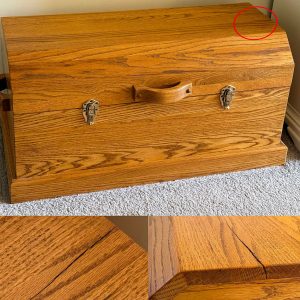
What’s my next project? At a small antique shop in Lebanon, Ohio, I discovered a utilitarian, hinged-lid box that’s perfect for small-item storage.  I also think it will be a fun project for the magazine. The original box was joined with dovetails at all corners, but I’m using finger joints, sometimes called box joints. They’re a close kin to dovetails, and there’s plenty of strength.
There are a few different methods used to make finger joints – a table saw setup (what I use most of the time), and a router jig (such as those from Leigh Industries, or the Keller Dovetail System) are but two. Another option is to use a router table.
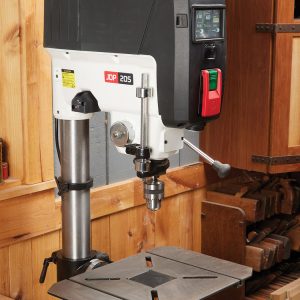
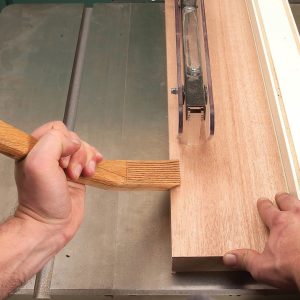
The table saw setup (as seen in the opening photo) uses the miter gauge, a sacrificial fence and a dado stack. The same setup can be used at a router table (shown at the right), but a router bit replaces the dado stack.
What method would be best to present in the magazine article? If you have an opinion, please share.