We may receive a commission when you use our affiliate links. However, this does not impact our recommendations.

For dovetails, I use what I call a “redneck slope” – 1:4 or 14°. I like this slope because I’ve seen it on a lot of vernacular pieces I’ve studied.
It says: Dovetail y’all!
And not: Ill-defined box joint. But that’s just what my eye sees.
Truth is, dovetail slopes are more about fashion than their mechanical properties. When I started woodworking, my head was injected with a lot of dogma about 1:6 and 1:8 ratios, softwoods and hardwoods, drawers and carcases.
But if you look at the historical record, you will find dovetails that are both nearly 1:1 in slope and those that are 2:1 (26.6°). These joints have survived for hundreds of years and show no signs of quitting.
Do what you like.
Or do what is appropriate for the furniture you like to build.
If you like 15th-century Italian pieces, you should consider a bold slope of 20° or more, based on the pieces I’ve inspected. If you like 19th-century work, pick something with much less slope, such as 1:8.
And if you make contemporary pieces, my only recommendation is to stay away from the slopes used by the manufacturers of dovetail bits for routers and dovetail jigs. Otherwise your pieces will look less hand-cut.
I wrote that sentence above and then looked at a couple catalogs of router bits. It turns out that a lot of dovetail bits use slopes of 7°, 9° and 14° – my preferred favorite angle.
Curses. Maybe I should use 13° instead.
— Christopher Schwarz
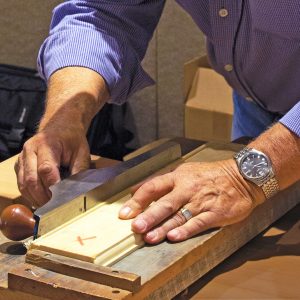
P.S. Want a dovetail marker? You can make your own or buy a nice commercial version. My favorite has always been the one from Sterling. You can also get a great one from Woodjoy. And Veritas makes some nice ones, too.