We may receive a commission when you use our affiliate links. However, this does not impact our recommendations.
I am planning to order a corner chisel, to use when I install hinges, and have
seen several styles. Which do you prefer?

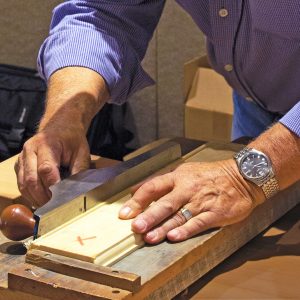
That’s a question I received from a reader, and the picture above shows the scenario he’s asking about. The piece of wood has a routed mortise with rounded corners. The corners need to be square for a hinge to fit, and the chisel he asks about is supposed to make this easy. As much as I like tools, this is one that nobody really needs. It’s a crutch that will actually keep you from developing a simple skill. A plain old chisel will remove the excess wood in the corner quickly and easily.

I routed the mortise deeper than normal to better show what happens with the chisel. The process works better if the layout lines are incised with a marking knife or gauge as well as a pencil. I recommend a mechanical pencil, but I don’t recommend the girly color unless you have a teenage son who habitually picks up every pencil he sees.
The key to doing this is to use the back of the mortise cut by the router, or the incised layout lines as a guide to place and align the chisel. I line up the corner, then pivot the chisel back toward me so that it is against the back edge of the mortise.

Making the actual cut is as simple as pivoting the chisel back down into the corner. The fingers of my left hand hold it in place while I push down on the end with my right hand. This is a finesse move, not a forceful one, and depending on the hardness of the wood it may take a few swings to reach the desired depth.

Coming the other way, you often don’t have enough of a straight edge to register the back of the chisel, but if the knife line is there, the edge of the chisel will fit. Again I start by putting the corner of the chisel on the corner of the mortise. When the back of the chisel is vertical, I plant my left hand to keep the chisel in line and push down with my right. This cut will offer more resistance, but a few seconds of pushing and wiggling make the cut.

A little bit of junk will be left in the corner, and it’s easily removed with a paring cut or two. Working toward the end allows you to push harder with the bevel of the chisel down. The paring cut can also be made with the bevel up, working at a right angle to the direction shown in the picture. The caution with that method is to push gently. There isn’t much wood behind the mortise, and an agressive cut can split out the back.

After you do this a few times it will become second nature, taking less time than it takes to describe the process. So save your money for the tools you really need.