We may receive a commission when you use our affiliate links. However, this does not impact our recommendations.

When woodworking magazines publish plans for a reproduction of an antique, we show you the details you need to construct a facsimile. We give you part sizes, joinery details and tips on how to perform the major operations in a modern shop.
But rarely do we give you the social, communal and historical context of a piece. We never try to investigate the original maker’s intentions, or discuss his or her relationship to the neighbors, family or village.
So as a woodworker, it was both alarming and thrilling to read Robert Tarule’s 2004 book, “The Artisan of Ipswich” (The Johns Hopkins University Press). This slim volume tries to capture the essence of everything important to 17th-century joiner Thomas Dennis as he built a chest for a client one November in his shop.
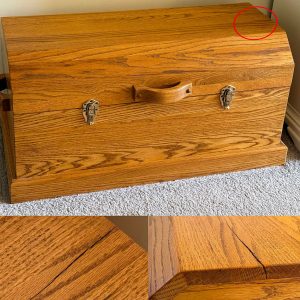
In this remarkable book, Tarule, a professional joiner, historian and former curator at Plimoth Plantation, takes a bird’s eye view of one example of Dennis’s work , a 47″-long lift-lid chest in oak with beautiful low-relief carvings. He begins the book with a bit of personal history to explain what led him down the curious path to reproducing 17th-century pieces for a living.
With his bona-fides established, Tarule begins to spin the tale of Ipswich, Mass., from its first mention in the historical texts to the time that Thomas Dennis settled there from England. Tarule’s insights into Colonial Massachusetts are surprising (if you had a particularly sanitized view of Colonial history from school, as I seem to).
What you quickly realize is that one of the most important things in 17th-century America was access to wood , for fuel, tanning, fences, construction, cooperage, wheewrighting and joinery. In fact, wood turns out to be a sort of currency among the artisans. And the right to cut wood was the source of lawsuits, fines and revenge.
And so Tarule delves deeply into the topic of wood (oak, in particular). He contrasts how it grew and was managed in the coppices in England with its forms in the New World. And then he weaves the dendrology into the fabric of Ipswich society, explaining all the town’s economic needs in terms of the wood.
As a joiner, Dennis needed particular kinds of wood for his work. So Tarule takes us into Dennis’s head as he searches the forest for the trees he needs, and he and a helper split the wood and as he prepares it for the chest (now in the hands of the Ipswich Historical Society).
Tarule obviously spent many hours studying this chest to try to tease out Dennis’s intentions. He uses every dimension, every knot and every stray tool mark to suss out how this chest was built and the mental processes Dennis employed to design the chest and organize the material to build it.
Because Tarule himself works this way (see his work at his Heart of the Wood web site), you can see that Tarule has faced the same decisions as he rived out the panels he needed for his own chests. And so the voice that Tarule gives to Dennis rings entirely true to me.
For the skilled woodworker, this book won’t teach you anything about how to cut a tenon or a mortise, but it will show you how to change your methods to match the goals of a 17th-century joiner. The book won’t give you precise part sizes that you can plug into your rip fence on your table saw, but it will show you how to use your material at hand to make adjustments as you go, and to sort out what is important and what is not.
But most of all, “The Artisan of Ipswich” will give you a deep appreciation for the work of 17th-century joiners and to see their pieces in a new light.
– Christopher Schwarz