We may receive a commission when you use our affiliate links. However, this does not impact our recommendations.
 It’s not often you get a chance to use egg-crate joinery in period furniture work. In fact, building the Carolina cellarette in the February 2013 issue of Popular Woodworking Magazine is the first time I have used if I remember correctly. When the time came to build bottle dividers for the bottom of the case, I looked at a couple ideas to construct the unit.
My original thought was to butt, nail and glue individual pieces together. Obviously, that was not going to work long-term, especially using 1/4″-thick material. I could have bumped up to thicker dividers, but that meant more work and a less-refined look. Finally, egg-crate joints came to mind.
I considered hand sawing the slots needed to join my pieces. While I have the chops to cut at my lines – a must if that is how you work – I could not use my dovetail saw because the joint required a 2 1/2″-deep cut and my blade cuts a wee bit less. Also, if the joint were too tight, I would have to plane the adjoining side because sawing a hair’s thickness using a handsaw is not my idea of fun in the shop. It is, although, a snap using a table saw.
 No, this was a table saw technique, and your first thought may be dado stack. Sorry, think again. An 8″-stack, which is common to use with 10″ table saws, cuts considerably less than 2-1/2″ when set at its maximum height. This needed to be cut using my regular 10″ saw blade.
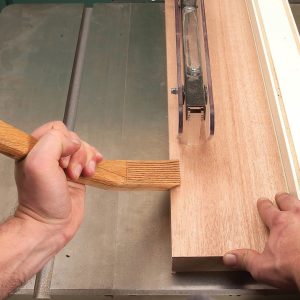
My first table saw attempt to cut the joint was a freehand effort using my miter gauge. Results were all over the place. Thick cuts. Thin cuts. There was no consistency. A second option of using stop blocks was too much of a hassle and not quick enough. As I looked at my zero-clearance insert, ideas soaked into the mush I call my brain. A zero-clearance setup on my miter gauge fence would work.
 In order to see the edges of the cut on my fence, I needed a thin piece on the bottom that would extend in front of the workpiece – thin because I didn’t need to raise the workpiece any higher. I nailed a piece of 1/4″-plywood along the bottom edge, attached the makeshift fence to my gauge then made a cut with my blade height at 2-3/4″ (2-1/2″ for the cut and 1/4″ for the carrier).
 The sides of my cut let me know exactly where to position my layout in order to achieve the perfect cut. It worked great. Also, make sure your fence is tall enough. It’s messy if you saw completely through the fence. No. I did not do that.
— Glen D. Huey, contributing editor
Editor’s note: Want more expert tips from Glen? Check out his new DVD, “Router Joinery & Techniques” – it’s chock-full of his professional (and fast) approaches to joinery, inlay and more.