We may receive a commission when you use our affiliate links. However, this does not impact our recommendations.

When I glue up panels from several narrow boards, I use my jointer plane to dress all the mating edges. While our power jointer is fairly well tuned, it’s rarely perfect , we have a busy shop. So I find it easier to dress my edges by hand than to fuss with the powered jointer.
My jointer plane has a cambered iron, which allows me to correct an out-of-square edge. (I’ll cover this in a future blog post after I pick up some Kevlar undergarments to protect me from the flak.)
Until I mastered using a cambered iron in my jointer plane, I used to use a straight iron and a jointer plane fence to dress my edges. I still use a jointer plane fence on occasion when I only have one or two chances at getting an edge dead-nuts square.
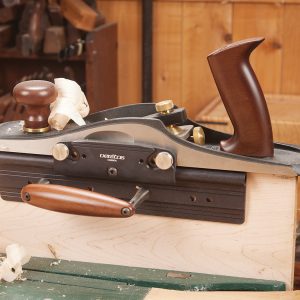
There are two kinds of commercial jointer plane fences. The more common one now is the Veritas Jointer Fence, which attaches to the plane with two rare earth magnets and a post that wedges the whole thing on your plane’s sidewall. This fence works with almost any bench plane, though I usually use it with a plane the size of a jack or a jointer (14″ to 22″ long).

The other kind of fence is like the discontinued Stanley No. 386. This fence attaches to the plane using thumbscrews. The nice thing about the No. 386 is that you can set it for a wide range of angles and it has a knob that I find useful for the edge-jointing process. The other nice thing about the No. 386 is that I can use it with a cambered iron because the fence is under the sole of the tool. The fence centers the plane over a typical edge, where the cambered iron is basically straight. (You can do this with the Veritas fence by adding a wooden block to the fence.)

The No. 386 can be tough to find in the wild. St. James Bay Tool Co. makes one that is similar, but I haven’t tried it.
How to Joint Edges With a Fence
Just like with using a power jointer, there is some technique involved in using a jointer plane fence.
Things to watch: The cutter has to be sticking out of the tool dead square. This is why I learned to use a curved iron in my jointer plane , it’s actually a more forgiving setup than using a straight iron.

Second: Use your dominant hand to push the plane forward and your off-hand to control the fence. With your off-hand, use your thumb to push the toe down against the edge and use your fingers to push the fence against the face of your board.
Third: What you have to understand about handplanes is that the tool’s cutter sticks out below the sole of the tool. As a result, the tool takes a slightly heavier cut at the beginning of the pass when only part of the plane is on the edge.
Last week I tried to measure this by edge jointing a 30″-long board and then measuring the shaving’s thickness at five points along its length. At the beginning of the cut (toe engaged only) my cuts were consistently .0055″ thick. In the middle and end of the cut the shaving was .005″ thick.
That is not much difference. But it can add up. After several strokes the edge develops a gentle curve to it. And that’s no good for gluing.
So here’s what I do: First remove some of the middle section of the edge. I start the cut a few inches in from the end of the board, and I end the cut a few inches from the end. I’ll usually take two passes like this. (This is similar to what David Charlesworth does, though I believe he continues to make passes until the plane stops cutting.)

Then I take a pass all the way through the edge. If I get one perfect unbroken shaving, I’ll test the edge with a straightedge or the board’s mating edge. If the edge is perfect or is a little hollow in the middle, I’ll get the glue and the clamps. If the edge still bulges, I’ll remove another shaving in the middle.
One more thing: Some woodworkers poo-poo the jointer plane fence. As Senior Editor Bob Lang might say: “You might as well show up on the job site wearing a dress.”
Well since today is “National Tartan Day,” I think you can get away with it.
– Christopher Schwarz
Looking for More Woodworking Information?
– Sign up for our newsletters to get free plans, techniques and reviews HERE.
– Looking for free articles from Woodworking Magazine? Click HERE.
– Like hand tools? Read all our online articles on hand work HERE.
– Want to subscribe to Woodworking Magazine? It’s $19.96/year. Click HERE.
Here are some supplies and tools we find essential in our everyday work around the shop. We may receive a commission from sales referred by our links; however, we have carefully selected these products for their usefulness and quality.