We may receive a commission when you use our affiliate links. However, this does not impact our recommendations.

Last Sunday, in The New York Times Magazine cover story, Michael Sokolove reported that in the world of sports, “Girls are more likely suffer chronic knee pain as well as shinsplints and stress fractures.” And, according to some research, ankle sprains, hip and back pain are more prevalent among women athletes, as are concussions in sports that both sexes play.
I guess I’m lucky. I played soccer for three decades and while my knees do hurt on occasion, I never tore an anterior cruciate ligament (aka ACL). After a mild sprain or two, my right ankle isn’t quite as strong as it once was, but I’ve never been on crutches for more than a week. And no concussions (at least none I remember). What finally ended the game for me was a snapped wrist during a stint as keeper. I was in a cast for four months, and my right wrist is now chronically weak , and I’m chronically afraid of breaking it again. (But for the record, I blocked that shot.)
The difference between men and women, according to experts Sokolove interviewed, is biometrics. Quite simply, men and women are built differently, and after puberty, men tend to add muscle whereas women tend to add fat, so women don’t have the same intrinsic strength to support muscle and ligament movements. And, because of women’s hip shapes, we tend to run differently. According to some experts, the female body can be trained to address these differences, which may reduce injuries.
I find a similar issue in woodworking from time to time. At 5’5″, I’m of average height for a woman. But the benches in our shop were built by men, and my bench used to belong to Editor Christopher Schwarz, who is just shy of a foot taller than am I. So, properly using a hand plane at that bench is for me impossible, as my elbows are always bent far more than they ought to be. This is an easy fix – either build my own bench…¦or wear high heels. (Thus far, I’ve opted for the heels.)


On the left, I’m wearing 4″ heels; on the right, I’m in flats.
Sawing is also a challenge, at least for some women. In “How to Saw” in the Spring 2008 Woodworking Magazine, Chris illustrates proper sawing stance, with his legs and body positioned straight on to the cut, and the elbow of his sawing arm swinging freely past his torso. Let’s just say that if I line my body up in the same way, my sawing arm cannot swing straight back unimpeded. In this situation, I opt to stand a bit left of center…¦or wear a sports bra. Again, it boils down to a fashion choice.
It took me a long time to get comfortable with our Powermatic table saw, too. Pushing a board through the cut is quite scary for me. Compared to the guys, my torso is a lot lower and closer to the blade when I lean forward, and my arms are a lot a shorter. So, my hand, arms and chest are always closer to the blade. Thus, I have to more often give up some workpiece control by using a push stick when one of the guys might not choose to use one.
And then there’s gloves (no, I don’t wear them at the jointer). One size does not fit all. It doesn’t even come close. Forget the home center or hardware store. When I need nitrile or vinyl gloves for messy finishing jobs, I have to drive miles to a medical supply store. And even then, I’m not always able to find women’s smalls.
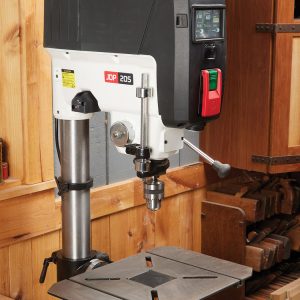
Hand-held tools can also be a challenge. We have some drills in our shop that I simply cannot pick up and use with one hand, due to their weight. And on others, the grip is far too large to be comfortable. I realize these tools are designed for the “average” user , but I do wish more manufacturers paid attention to the fact that far more women are now buying and using tools. I don’t think our relatively smaller frames and hand sizes are usually factored into that “average.” (Of course, my chronically weak right wrist doesn’t help matters. Darn , guess I can’t use that Firestorm pictured above.)
In my soccer “career,” until college I was usually the only girl on the team. I wasn’t the best player, but I could hold my own. By age 16, most of the guys were faster, stronger and a whole lot bigger than was I. So I compensated by improving my blocking, tackling and passing. I’ve had to learn some similar “fixes” in woodworking. And of course, it affords me the opportunity to match my pounce bag to my shoes.