We may receive a commission when you use our affiliate links. However, this does not impact our recommendations.

Teaching someone to cut dovetails is easy. Teaching them to joint an edge for glue-up with a handplane is something else.
If you don’t believe me, consult Joseph Moxon, who wrote the first English-language book on woodworking.
But yet it is counted a piece of good Wormanfhip in a Joyner, to have the Craft of bearing his Hand fo curioufly even, the whole length of a long Board; and yet it is but a fleight to thofe, Practice hath inur’d the Hand to.
Translation: Edge-jointing takes practice.
So when I teach people to do it, I struggle as much as they do. I show them how they are tilting the tool. I show them how to fix the problem. Then they make it worse. After jointing the same edge 20 times over, it becomes almost impossible to correct (without a jack plane).
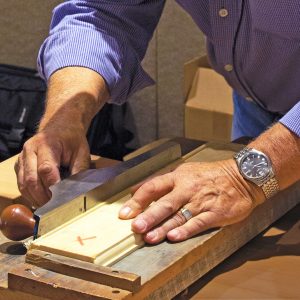
A couple months ago, one of the students in my campaign chest class at the Marc Adams School of Woodworking showed me a little L-shaped jig he used for edge jointing and it blew my mind.
Sure, I’ve seen all manner of commercial fences and long-grain shooting boards and whatever. I have seen it all (but I know you will still tell me I haven’t).
Anyway, this little block of wood clamped to his plane makes edge-jointing a breeze. You don’t even need to have a straight iron. If your iron is cambered you can adjust it laterally to make a square cut.
I told the student to submit the jig to Popular Woodworking Magazine as a “Trick of the Trade” and he did. It didn’t win as the best trick, but it is featured in the latest issues as one of the worthy trick.
Since that class, I have been using this jig to teach edge-jointing. Though a few people don’t like it, most people benefit greatly from it.
If you make one of these jigs, here are a couple tips for using it. First: clamp the jig so it is slightly ahead of the iron – but not too much. If the jig is too far in front of the iron you will have a difficult time with the dismount.
Second: Skew the plane slightly when you use this jig. Skewing will make only one corner of the jig register against your work and reduce the drag. Try it.
Anyway, pick up the latest issue of the magazine. Or subscribe….
And most of all, take the 2:34 required to build the jig and try it. I think you will be thrilled.
— Christopher Schwarz