We may receive a commission when you use our affiliate links. However, this does not impact our recommendations.

Shellac is my finish of choice for furniture. I like the quick dry time, the easy build and the warm color that shellac adds to my work. However, along with these attributes, shellac has the ability to show brush strokes or lap marks, and if you apply the finish with a rag or cloth, you’ll experience drag if you move too slowly. In each scenario, the finished surface is not exactly smooth. For those reasons, I spray shellac, but I know that there are still those out there who won’t take a dip in the spray finishing pool. Another solution may be this technique shared with me during a seminar in New Jersey this past weekend.
The technique is to add mineral oil to shellac in a ratio of 25 percent oil to 75 percent shellac. The oil allows the cloth to flow over the shellac without any drag or noticeable lap marks. OK , the key word here is cloth. This technique works only when padding on the shellac , much like one would do when French polishing. (Stay with me, I’m not suggesting that you do a French polish.)
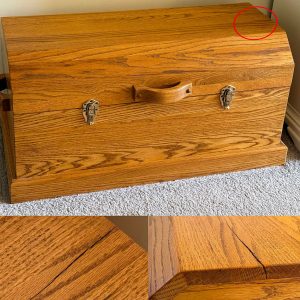
I experimented with this mixture and was amazed at how it worked. I found the shellacked surface was smoother than the surface on which I ragged on straight shellac. There was little difference in build between the two products, and as you can see in the photo below, the sheen and build are nearly identical, at least to my eye. (The left-hand side is the mixture and the right-hand surface is the right-from-the-can shellac.)
An oil/shellac mixture is not like an oil/varnish mixture. An oil/varnish finish usually needs three or four coats for a nice build. It took 14 layers to get the build shown in the photo , way too much time spent and muscle depletion for me. I’m not using this mixture only as my finish, but I would consider this a last coat possibility.
Here’s what I would do. Brush the shellac onto your piece to build a solid thickness. Don’t worry about brush marks, but try to keep them to a minimum – I still believe in the saying, “A better brush gives you a better job.” Once you’ve established the build, sand the entire project to remove any brush marks that do appear then apply a coat or two of the oil/shellac mixture. It’s easy to apply and quick to dry.
You don’t have to rush the padded-on mixture to keep a wet edge. As a result, your finish should be smooth. You will find oil sitting on the surface. That oil should be wiped with naphtha a day or so after the finish is complete , the oil doesn’t dry, so it floats to the surface. The opening photo is a great example of the separation , unlike wax in shellac that settles to the bottom, the oil rises to the top.
For more information about finishes:
- Go here to read Bob Flexner’s article about finish compatibility.
- Visit here to pre-order a copy of Flexner’s upcoming book “Flexner on Finishing.”
- Click here to purchase a DVD on “Finishes That Pop” and learn how to make your projects stand out.