We may receive a commission when you use our affiliate links. However, this does not impact our recommendations.

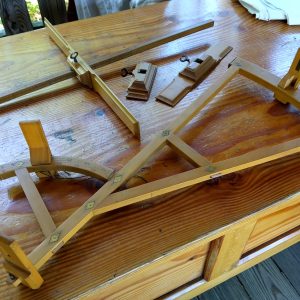
This is my favorite picture of the ones I’ve taken while documenting the class. Here we’re routing out the cavities for the bolts that hold the workbench bases together.
When you teach anything , animal husbandry, frog gigging or brain surgery , here’s some advice for you: Don’t give demonstrations after lunch.
Today in class we had a lot to accomplish; the goal was to get the bases ready to assemble on Friday morning. It was an ambitious plan, and the students worked quietly and diligently all morning to tune up their tenons and mortises.
Lunch today was shrimp Creole (Kelly Mehler always provides hearty hot lunches). And it smelled really good. I didn’t actually eat the Creole. You see, it’s not that I have a thing against chomping our crustacean chums, it’s that I have a thing against lunch. If I eat a big lunch, then I want to crawl under my workbench and take a nap. I learned this in kindergarten, where it was encouraged. Then they beat it out of you, which is no fair.
So I eat a light lunch. Greek yogurt. Some fruit. Maybe a cup of coffee. That way I’m quasi-perky come 1 p.m.
After lunch, one of the students, we’ll call him “Rob the Canadian,” asked if I would give a demonstration on drawboring. Rob the Canadian was at the point in his project where he needed the demonstration to proceed with his workbench. He’s a meticulous craftsman, incredibly driven, and he is a few steps ahead of the rest of the class as a result.
A little voice inside my head said that drawboring and digestion don’t play well together. But I wanted to keep Rob on track. Plus, I beat the tar out of things with a mallet during the demonstration, and I say funny words like “old groat.” So I agreed.
And 20 minutes into my demonstration Rob the Canadian drifted (briefly) off to sleep.
There’s more to the story (including some fairly hilarious teasing that continued long into the day), but we’ll just let that part of the story stay in Berea.
After waking up Rob the Canadian, I continued the demonstration. And that’s when another student, we’ll call him “Larry the Alaskan,” dropped a bomb on me. Larry the Alaskan recently took a three-month course in timber framing, and they also used drawboring (albeit on a much bigger scale).
One of the most stressful parts of drawboring is driving in the peg through the offset holes you have bored. The peg can pull up your joint tight (that’s good), or it can explode (that’s bad). Larry the Alaskan said that he was taught to simply wax their pins before driving them.
So we tried it on one of the student’s bases. All I can say is “wow.” Driving a 5″-long waxed oak pin through hard maple has never been easier. In the past, I’ve been driving my pegs while they were coated with nothing, hide glue or yellow glue. All three of the techniques have advantages and disadvantages.
But coating them with wax? That is genius. It’s such a good tip, I almost don’t feel like I should get paid for today’s work. Well, unless you count the bit of sleeping therapy I provided.

Rob the Canadian and Kelly Mehler look over his assembled workbench end after drawboring the oak pegs through the mortises.