We may receive a commission when you use our affiliate links. However, this does not impact our recommendations.

The only awful grade I earned in high school was in my second year of French class. Despite my best efforts, I could only eek out a B- during the first semester. Of course, it didn’t help things that I was 18 and smitten both with my French teacher and Jodi Huth, the girl who sat next to me.
Now more than 24 years later, I wish I had stuck with French through college and resisted those two Francophone vixens. A better command of the language would allow me to make more sense of AndrÃ?© Roubo’s “L’art du Menuisier.”
That’s why I’m glad that Don Williams and a team of woodworkers and translators are piecing together a translation, which Williams discussed during our “Feast of AndrÃ?© Roubo” dinner at Woodworking in America. The first of two volumes should be ready next year.
To illustrate what a huge effort this is, let’s look at my own lame attempts to work out the details of one section. As I was researching Joseph Moxon’s double-screw vise earlier this year for “The Workbench Design Book,” I took a crack at Roubo’s Plate 280, Fig. 3. This plate clearly shows a refined double-screw vise. And unlike Moxon or Randle Holme, Roubo gives us some details.
The first section translates like this:
After the workbench, the presses are the largest cabinetmakers tools: they are of two kinds, viz, those fig. 1 & 3, whose movement is horizontal, And whose heads of the screws were drilled to receive bolts of iron used to make them move.
OK. That’s not too bad in the gibberish department. Let’s go on.
These presses are composed of twin (chops) AB & CD, which are 5 to 6 inches wide, (and) about 3 to 4 inches thick, because of their length, which varies from 2 to 4 feet, and in one both, that is to say, in the AB, the screws are threaded, instead they all come alive in another.
This is helpful. Now we know that these presses are fairly large, which helped me size mine when I built my first prototype. And we know that the rear chop is threaded. But the “instead they all come alive in another” stumped me a bit. Next!
The length of the screw press should be about two-thirds the length of (the chop), of 2 to 3 inches in diameter: and we must take care that their heads are (bound) by a ring of iron to prevent it from cracking when they are cinched down hard.
I think this passage is easy to follow. Now for the hard one:
See fig. 1 & 3. We use these presses on the workbench with the rip tip, either for work or work to stick. In one or other of these different cases, we stop the press on the bench with two (holdfasts so) that it (will not move).
The way I read this sentence is that the vise is used for ripping (such as dovetailing) and perhaps for sticking moulding.
Want to take a crack at the French yourself? Download the original (minus the accents etc.) below.
– Christopher Schwarz
Other Workbench Resources
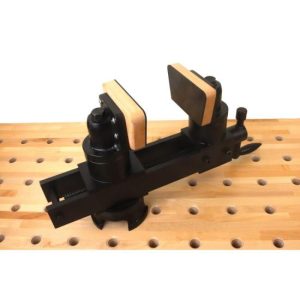
– Our new “The Workbench Design Book” is now shipping. It’s available only through our bookstore and Lee Valley Tools. It features plans for the double-screw vise shown above.
– You can order a nice poster of AndrÃ?© Roubo’s famous Plate 11 from our store. It’s a great piece of art for your shop wall.
– Want to see and use this double-screw vise? Take my sawing class next weekend here in our shop at Popular Woodworking Magazine.