We may receive a commission when you use our affiliate links. However, this does not impact our recommendations.

For many years I’ve lined the jaws of all my vises with sueded leather to improve their grip. Whenever I mention that I do this, I get a barrage of questions:
- Where do you buy suede? (Really? Any craft store, fabric store, Tandy etc.)
- What glue do you use? (Any glue. Hide, yellow glue, epoxy, contact cement etc.)
- How do you apply the leather? (Like veneer. Clamp a caul on the leather and let the glue cure).
Despite those above instructions, many woodworkers hesitate. And so I offer this simpler solution: adhesive-backed cork contact paper, which you can buy at any decent kitchen store. I bought mine at The Container Store.

After getting a tip from some chairmakers, I’ve began experimenting with using cork floor tiles, wall tiles and other bits of cork in the shop. I wasn’t happy with the floor tiles or wall tiles because most were really thick, and it was difficult to find ones that were self-stick.
So I’ve settled on cork contact paper, usually used to line shelves or drawer bottoms in kitchens. The cork is about 1/16” thick and has a paper back that covers the adhesive. Cut the cork to size with a shop knife, remove the backing and stick it in place. That’s it.
The contact paper is also nice because the paper backing has a cutting grid on the back (sort of like wrapping paper), which makes it easy to get precise and square cuts.
The cost? It was $10 for a roll that was 18” x 48”.


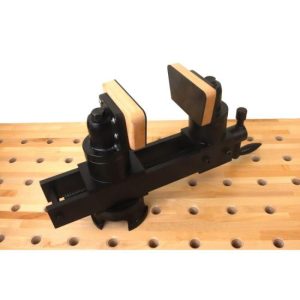
I lined the chops of my leg vises with the stuff and even put it on the underside of the doe’s foot I use instead of a tail vise. It grips just as well as leather. I think I’m going to line the bottom of my tool chest’s sliding trays with the leftovers.
(Oh, one more detail because I know it will come up: It’s OK to put the cork (or leather) on the front edge of the benchtop. No, it does not affect edge-jointing. You’ll just have to trust me on this one.)
— Christopher Schwarz
For more workbench advice, check out my newly revised “Workbenches: From Design and Theory to Construction & Use,” available at ShopWoodworking.com.