We may receive a commission when you use our affiliate links. However, this does not impact our recommendations.

The most embarrassing jig I’ve ever owned has been photographed, measured and pondered more than any single piece of fine furniture I’ve built.
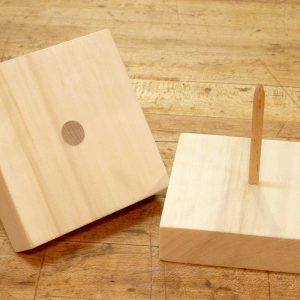
It’s a stupid little block of wood with stops on it for many common chisel sharpening angles I use with my side-clamp honing guide – sometimes called the “Eclipse” guide because that was an original manufacturer.
Making a chisel sharpening jig with stops for a honing guide isn’t a new idea. It shows up in the earliest woodworking magazines and has been taken to a high art by Deneb Puchalski of Lie-Nielsen Toolworks. Download free plans from the Lie-Nielsen site here.
I think the appeal of my version is that it takes up little space and is so crude that anyone can build it. I get asked all the time for plans for it. So here’s how I build one.
First examine your chisel honing guide. If it’s one of the Taiwanese ones, then the following measurements will be correct for the different angles. If you have an English one labeled Eclipse 36 or some such (lucky you!), then you will need to figure out the measurements because the English-made guides are smaller.
Build the jig out of junky scraps – I used a scrap poplar 1×4. The base is 10-1/2” long. Then crosscut four 3/4” x 3/4” stops from the 1×4.
The next step is to nail the stops to the base. The distance that the stops are located from the edge of the base determine the angle the tool is held in your honing guide.
OK, I am now trying to find my power animal. Calm my aura. Take a frickin’ chill pill. Why? I am about to discuss sharpening angles. Allow me to lay some hard-earned truth on you: The exact angle you sharpen at with your honing guide isn’t as critical as the same angle you used last time you sharpened. Period. Read that sentence until it sinks in. Consistency is more important than accuracy.
Setting the exact angles of plane irons is tricky in these side-clamp guides because … oh I don’t think we should go into it. People will fall asleep. Join a woodworking forum and you can read the dissertations on the topic.
The bottom line is that if I put the thinnest plane iron in my honing guide and set it to extend 1-1/2” from the front of the jig, it will sharpen the tool at 30°. If I put the thickest plane iron I have in my shop in the honing guide and set it to extend 1-1/2” from the guide, then it will sharpen the tool at a little more than 31°.
Does that matter? No, no and no.
The point is that a 1-1/2” projection will return your tool to that same angle every time you sharpen. This will greatly reduce your time on the stones and save abrasive material, steel and a family of sea lions.
So for plane irons, nail a block that is 1-1/2” from the edge of your 1×4. Label it 30°. Nail a block at 1-9/32” from the edge and label it 35°. Then nail a block that is 3-3/8” from one end of the block. That will be used to set your plane iron to sharpen a 15° back bevel on a plane iron.

(Note: If you don’t know about back bevels, keep your pants on. I’ll do a blog entry on that later this week.)
Turn the block over.
The other face of the 1×4 is for chisels, which are held in a different notch in the honing guide. If you need to check the angles produced by your particular guide, clamp a ruler in the guide and use that to check the angle on a protractor.
If you have the ubiquitous (Megan taught me that word) honing guide, nail a block at 1-3/16” from the edge for 30°. Nail a block at 15/16” to get 35°. If you want other angles (I don’t), then you can figures those measurements out with ease.
And that’s it. Apply a French polish to the jig – I recommend 10 coats – and then some conservator’s wax.
— Christopher Schwarz
Want to see this jig in action? Order my DVD “The Last Word on Sharpening,” one of the DVDs I’m most proud of. It’s not about the best system of stones ever. It’s about grinding, honing and getting back to work. It’s about finding the system lurking behind all those sharpening systems out there so you can make good decisions and buy only one sharpening kit for your shop.
-

- Photo courtesy Chipstone Foundation