We may receive a commission when you use our affiliate links. However, this does not impact our recommendations.

All dovetails: The corners of this chest are all constructed using full-blind or half-blind dovetails.
When I took my first woodworking class in 1993 I was gung-ho to learn two things: through-tenons and through-dovetails.
At the time I was intoxicated by Arts & Crafts furniture and exposed joinery. For many woodworkers, I suspect that exposed joinery sends a message: This piece is made well. It’s not made using corrugated fasteners, hot-melt glue and rubber bands. It’s like buying a fried chicken breast where you can see the bones instead of a chicken nugget, where you cannot see the beaks.
So I spent years perfecting these exposed joints to get them looking seamless right off the saw. I don’t regret those years of effort. But as I’ve gotten older, my tastes have changed. I still love bomb-proof joinery, but I don’t really feel the need to show it off to the world.
To be sure, some people are going to look at my furniture and assume it’s more like a chicken nugget than the real bird, but I can live with that.
So what do I focus on these days? In no particular order: form, crispness of detail, the fit of the movable components, the surface finish and (this is huge) the grain. Oh, and the hardware, but you knew that.
This week I finished up building the two carcases for this Campaign Secretary I’m building for Popular Woodworking Magazine. These cases are chock-full of dovetails, but when the whole thing is together it just looks like two boxes with a couple rabbets.
I love it.
What I see when I look at the carcase is not the lack of joinery. Instead, I see the fact that the grain is a continuous flow from the bottom edge of one end, across the top and down to the other bottom edge.
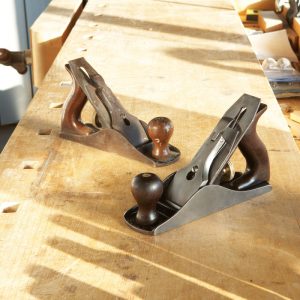
I also like the back of this piece. It’s not flashy, but I had to use a fore plane to dress everything flat and I left the traverse marks left by the curved iron, what Joe Moxon called “dawks” in his 1678 book. That texture, even though it will be hidden, says “handmade” to me now.
Of course, after I finish this chest, my next Campaign-style case piece is going to smash all my above sentiments. Think: riveting the wood.
— Christopher Schwarz
But if you struggle with dovetails….
Check out Chuck Bender’s DVD “Dovetailing Apprenticeship” – an excellent way to learn from a real master of the joint. If you want to try a bunch of different hand-cut joints, Ron Herman’s “Joinery Challenge” DVD introduces you to nine essential joints. If you like books better, hunt down a copy of Charles Hayward’s “Woodwork Joints.” It’s the standard.