We may receive a commission when you use our affiliate links. However, this does not impact our recommendations.

When I was first learning to use a handplane, I was both intimidated and skeptical of some of the claims made by the “handplane gods.”
The gods claimed they could plane any species of wood, with any grain direction and with any sort of figure in the wood without the wood tearing out. So what was the secret of the gods?
Sometimes it was the tool (usually an infill plane, but sometimes a Bedrock that had spent some time in a peyote hut in New Mexico getting in touch with its inner frog). Or sometimes it was their sharpening skill and waterstones (#100,000-grit stones, or perhaps the trail of split hydrogen atoms they left in their wake.) Sometimes the secret was their skill , they could plane any board with a piece of tin foil taped to a Monchhichi doll.
But I was skeptical, because these boasts were never accompanied by photographic evidence.
So here’s a bit of truth about my own work. I’ve been handplaning boards for more than 15 years now, and I still fight and struggle with tear-out, even in some domestic species. Usually, the way I deal with tear-out is to choose my wood with extra care and stay away from boards that are going to give me trouble. Careful planning makes for easy planing.
After that, I must say that I have the most success in removing tear-out by using a plane with an iron pitched at a high angle (usually 60�° to 62�° , whatever my honing guide can manage).
This week I’m building a blanket chest for the Summer 2008 issue of Woodworking Magazine, and the wood is some kicking tiger maple that I bought from a fellow woodworker’s private stash. While machining all the boards, the grain tore out in some critical spots.
Then I flattened all the boards and assembled panels with my jointer plane. It was freshly sharpened, pitched at 45Ã?° and set for a fairly light cut , .003″ or .004″ I’d say. The tear-out didn’t recede much, but I didn’t panic.
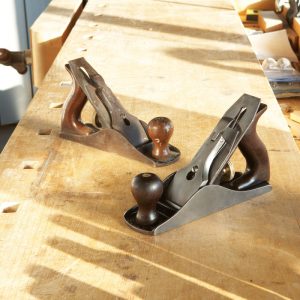
That’s because I have a plane with a 62Ã?° angle of attack that is for just this purpose. The one shown on my bench is the Veritas Bevel-up Smoothing Plane, but don’t take that as an endorsement of that single brand. I have a Lie-Nielsen version at home (the low-angle jack) set up identically. And I can even get this 62Ã?° angle on a standard old-school handplane by honing a back-bevel on the iron.
I guess what I’m trying to say here is that it’s not the tool as much as it is the angle.
The photos show the results of the high-pitch plane. The tear-out took about eight passes to remove with the tool set to take an extremely thin shaving. I don’t think I’ve entered the realm of the handplaning gods, but when you have small victories like this, it sure makes you feel like one.