We may receive a commission when you use our affiliate links. However, this does not impact our recommendations.

A few weeks ago I was reading through “The Rule Book,”
an amazing piece of scholarship on measuring tools by Jane Rees and
Mark Rees. A few of the minty, minty old rules in the book really caught
my eye.
How, I wondered, could something so old look so new?
The
photo’s caption offered an answer. These tools had been found inside
the joists, studs and foundations of old buildings. Presumably they had
been lost by the craftsmen during the construction of the building and
were protected from light, moisture and the evil brass wire wheels of
shady tool dealers.
When I first read that explanation, I scoffed
into my beer. I know how important the two-foot rule is to an early
woodworker. I couldn’t imagine that an expensive tool like that could be
lost so casually. But hey, Jane Rees is the real expert (Mark passed
away some time ago).
Within a couple days I found out that yes, Jane Rees really is an expert.
I
was in the basement of my shop that I am sprucing up and was installing
some chair-rail moulding over some beadboard wainscott. Whenever, I’m
in a tight spot like this, I end up using a flush-cut saw quite a bit.
In this case, I was trimming back some lath strips to fit the chair
rail.
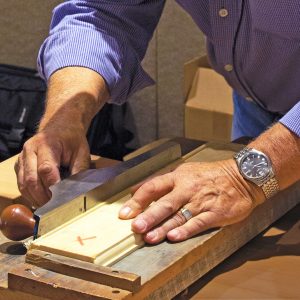
Here at the magazine we all have a favorite flush-cut saw – the kugihiki saw sold by Lee Valley. We prefer it to saws that cost four times as much.
I’m
sure you know what happened next. I dropped my saw between the
wainscott and the foundation. It dropped about five feet to the
subfloor. Behind the baseboard. Behind the shoe moulding.
So
here was my choice: Spend several hours ripping out a section of the
wall, baseboard and shoe moulding to retrieve my little saw, or I could
finish installing the last piece of chair rail moulding and call the job
done.
Sometime in the distant future, when tool historians write
the scholarly “Flush-Cut Saw Book,” my minty, minty tool could be
featured there. It’s waiting there, patiently, to be discovered.
— Christopher Schwarz