We may receive a commission when you use our affiliate links. However, this does not impact our recommendations.

As I was unpacking my tools for the Lie-Nielsen Hand Tool Event in Chicago this weekend, John Economaki from Bridge City Tools stepped up to my workbench with an astonishing piece of wood.
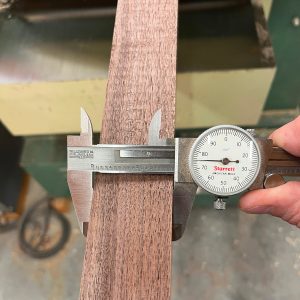
It was a narrow slice off the end of a dowel that was .004″ thick. It was cut with a handsaw.
“I cut this with my new saw,” Economaki said. “You ready for a rematch?”
Earlier this fall, he and I had a sawing contest to see who could make the thinnest crosscut (he won that contest; see the full story here). Economaki handed me the paper-thin slice and I knew two things: I didn’t want a rematch, but I definitely wanted to see his new saw.
Turns out it is more than just a handsaw. It’s a Japanese sawblade mounted in a frame that was topped with sliding tables. It is, in essence, a hand-powered table saw with sliding tables. Economaki calls it the Jointmaker Pro, and it’s going to be available this summer (most likely June, Economaki said).

In this photo, Economaki pulled away the stops so you can see what the cutting action looks like across the sloped blade.
Here are the particulars: The sawblade is mounted teeth-up in the frame of the Jointmaker. And the blade slopes up from the front of the tool to the rear. On top of the Jointmaker are two sliding tables , one on either side of the blade , that slide on dovetailed ways (no bearings, just a perfect fit).
Some of the controls are like a table saw: You raise and lower the blade with a crank, and you can bevel the blade left and right. To make common cuts, the Jointmaker Pro comes with a series of stops that you can set for the particular bevel angles.

Look familiar? The Jointmaker Pro has controls similar to a table saw. And as a bonus it bevels both left and right.
The two sliding tables can be moved in tandem at any angle between 0Ã?° to 47Ã?° by securing the Jointmaker Pro’s wooden fence across them. Then you simply secure your work on the table with a couple very clever hold-downs and , zip , push the work over the blade.
The slope of the 28-tpi crosscut blade (a rip blade is available) cuts the work with surprisingly little effort. But how much wood can you cut with a human-powered table saw? Economaki said you can cut stock up to 5″ wide and 1-1/2″ thick. Thick stock requires a lot more strokes against the blade, but it’s easy (I tried it).
What is most surprising about the tool is the resulting cut. It is the cleanest sawcut I’ve ever seen, whether by hand or power. Economaki made dozens of different kinds of cuts during the hand-tool event for dovetails, tenons, half-laps and bridles , and all them were flawless from the saw.
At the end of the show, he made a series of compound miters, and they went together with an air-tight fit.
Economaki said the idea for the tool came to him during a sleepless night.
“I began by putting a Japanese saw blade upside down in a vise,” he said. “I made a cut by pushing the work over the blade, and the light went on.”
The Jointmaker Pro will cost $1,195 retail, Economaki said, but there will be an introductory price of $995.
“It costs 10 times that of a good dozuki,” he said. “Yet you get perfect results.”
– Christopher Schwarz