We may receive a commission when you use our affiliate links. However, this does not impact our recommendations.

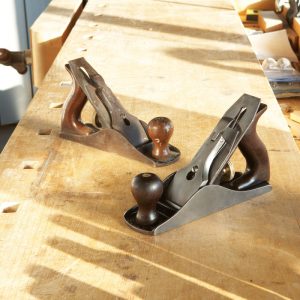
I’ve got a weakness for shoulder planes. Though lots of people do great work without them, I find them useful for trimming the shoulders and cheeks of tenons, plus fine-tuning rabbets, half-laps, shiplaps and dados.
That said, I think that one of the weaknesses of the traditional shoulder plane has been the ergonomics of the tool. They are awkward to hold for some operations, and so most woodworkers develop special grips that make your forearm and hand look more like a claw. 
This week John Economaki at Bridge City Tool Works loaned us one of his new Ã?¾” shoulder planes, the HP-7, for a shop trial, and I was immediately impressed with the tool on all counts. Its design is reminiscent of some of the custom English shoulder planes from the 19th century that collectors call the “rhino horn” pattern , because of the prominent grip at the front of the tool.
I really like the rhino horn pattern plane and find the horn an excellent place to grip when pushing the tool with one or two hands. But there are many more details to the HP-7 worth noting.
This tool has a nice rear end, or (put more politely) a surprise ending.
The stainless steel grip at the back melts right into your palm and the tool feels like an extension of your arm. Your fingers (and thumb) fall into two milled semi-circular areas on the sidewalls of the brass body. The tool’s depth adjustment and the mouth opening are controlled by two knurled adjustment wheels inside the body. This means you don’t need to use a screwdriver to adjust the mouth , a nice touch.
The real surprise is when you go to remove or coarsely adjust the iron. You lift up the steel grip and the lever cap also swings up , like the doors on a gullwing car. It’s so cool I think I did it about 30 or 40 times and showed everyone in the office. The other surprise is how you remove the iron , you pull the throat plate forward and remove the iron through the throat (with other shoulder planes you take it out the rear). There’s no real functional difference here in my opinion, but it is a difference.
The tool has a thicker iron than any shoulder plane I’ve ever seen. The sucker is a full Ã?¼” thick. And the HP-7 weighs more than other premium Ã?¾” shoulder planes. It tips in at 2 lb. 12 oz. The Veritas is 1 lb. 15.7 oz. The Lie-Nielsen is 2 lb. 5.4 oz. You can really feel that extra weight during use, and it comes in handy when plowing through the end grain of shoulders especially.
When pressed into service, the tool was very nice to hold when upright or flat on its side. It performed beautifully, which isn’t really any surprise. The extra weight helps keep the tool in the cut. The nice ergonomics keep your hand from cramping.
The tool retails for $589, which makes it considerably more expensive than the Veritas (about $160) or the Lie-Nielsen ($175). I’m supposed to return the tool to John Economaki when he comes here for a visit in June, but that might just be enough time for me to sock away enough money to hand him a check instead.