We may receive a commission when you use our affiliate links. However, this does not impact our recommendations.

This week I’m at my father’s house in Charleston, S.C., to get my USRDA of grits, tasso and shrimp. Whenever I visit the Holy City, I always make sure to pack comfortable shoes and a tape measure , I never know what I’ll find.
This morning I’ve been poring over my father’s small collection of English chests. Most of them he purchased from dealers on King Street a few blocks away. When I helped him pick these chests out, I was always looking for the ones that displayed the best craftsmanship. These well-made chests, however, weren’t always the best-looking chests. So usually he purchased a chest that looked really good and was passable in the craftsmanship department. Funny, he doesn’t take me with him to shop for antiques anymore.
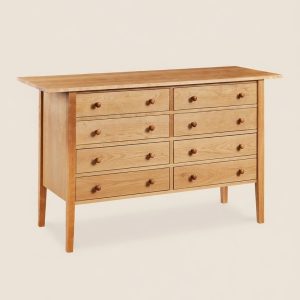
One of the chests in father’s dining room is similar to a piece I’ll be building at home this year. The chest is circa 1810, according a friend of my father who deals in Early American architecture and furnishings. It has some interesting details from the woodworking side of things.
The chest is a typical size: 39-1/8″ high, 37-5/8″ long and 19-1/4″ deep with four graduated drawers: 5-1/4″, 6-3/4″, 7-3/4″ and 8-3/4″. The entire chest is pine that has been veneered with mahogany.
The top is an interesting construction. The front 4-1/2″ of the top is 7/8″ thick. The rest is 3/4″ thick. I assume that the 7/8″ piece is edge-glued to the 3/4″ piece , at least that’s the way it looks.
As always, the drawers are interesting. The sides and back are all 3/8″-thick material. The front is 3/4″ pine veneered with mahogany (with some string inlay). Each drawer has a tail at its bottom edge that is straight instead of sloped. This straight tail houses the groove for the drawer’s bottom. Like all my dad’s English chests, the bottom of the drawer sides have been reinforced with small strips of wood to effectively double the thickness of the drawer side under the bottom.
The drawers in this chest run on solid dividers , no web frames in this chest. The back is four wide boards of pine in a rabbet. No shiplaps or grooves as far as I can tell , the backs have shrunk a bit, and you can see between them.
I really like the flowing lines of the plinth (they are repeated on the sides) and want to trace them before I leave. I’ll have to keep my eye peeled for some wide butcher’s paper in town.
– Christopher Schwarz