We may receive a commission when you use our affiliate links. However, this does not impact our recommendations.

The historically correct shape of the drawbore pin shown in our Autumn 2005 issue has come into question this week. Joel Moskowitz, a tool historian (correction: and a user) and the owner of Tools for Working Wood, reports that his pins are not a straight taper but are eccentric in cross-section instead (“eccentric” is my word; he calls it an “oblique cone” in his comment below). So one side has no taper. This, he reports, causes the joint to tighten up with the twisting action required as the steel pin is inserted. Interesting!
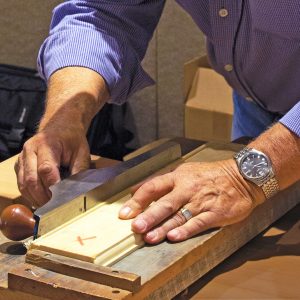
The drawbore pins I’ve made over the years have used machinist drift pins from Sears. These have straight tapers , no eccentricity. Intrigued, I went out and examined closely the antique smallish English set in my toolbox (shown above). They have a straight taper. In truth, one of them is bent so you couldn’t call it a “straight” taper really. A “crooked” taper perhaps? Also, they are not oval-shaped in any way. I put my dial caliper on them in several locations and found them to be of a consistent diameter as they tapered , cone shaped, really.
When I researched this article I bought four other sets of English pins (really, honey, it’s all in the name of journalism). I haven’t been able to check these yet as they are loaned out to people in far-off places. But I’m putting out the word today for them to examine them.
Also today, I consulted Paul N. Hasluck’s “The Handyman’s Book,” which has several drawings related to drawboring on page 204. The large drawing of a pin looks like a straight taper to me , of course, you cannot see it in cross-section, which would have been helpful, Paul. One of the drawings, Fig. 634, shows the pin being inserted, and it could be eccentric.

A drawbore pin from Joseph Smith’s “Key to Sheffield Manufacturers”
If you own a set of these pins, could you check them out and send me some information on the shape of the steel pin on your set? I’ll be happy to post the results here. Also, from a user’s point of view, I’ve been drawboring since 1999 or so with straight tapered pins, and they work great. And John Alexander also recommends drift pins on his site. So my instructions on making your own pins stand, unchanged. I wouldn’t give up my shop-made pins for anything.