We may receive a commission when you use our affiliate links. However, this does not impact our recommendations.
Procrastination isn’t always a bad thing. When we last looked at my pile of 2 x 4s the readings from my moisture meter ranged from 10 percent to 18 percent. My reason for using this stuff was price , a “precut” (almost 8′ long piece) cost $2.38 at our local home center. Good price, but if I tried to work with it in that condition, my finished benches would have twisted as the wood reached equilibrium with our shop environment. Cutting them to rough length and putting stickers in between helped to speed the process. Late last week I was getting consistent readings of 9-10% at the middle and the ends of my boards and decided it was time to proceed.

Without a meter, you’re left to guess about how wet the stuff is. One way to judge is by weight; drier pieces are lighter. Wet material will also feel cold and damp to the touch. Comparing new lumber to some that has been around for a year or so will also help you judge.
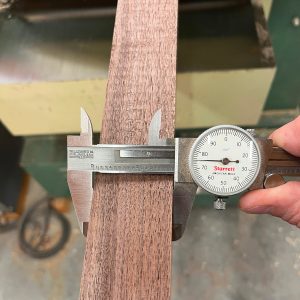
The lumber did twist and cup a bit as it dried, so I ran all the parts over the jointer and through the planer. The finished size is 1-1/4″ X 3-1/4″. I came up with this process for building benches and stands for tools about 15 years ago when I was setting up a shop from scratch. Every nickel I could save on shop fixtures was another nickel I could spend on power tools or disposable diapers. Here is the same stack of wood after milling.

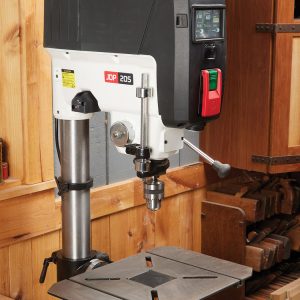
It’s not quite perfect, but much better than it was. I’m making a stand for a small drum sander (which would also work well for a lunchbox planer) and one for our hollow-chisel mortiser, which would also be a good size for a drill press. The system is based on two components , legs and frames.

Each leg is two pieces glued and screwed together to form an “L.” This makes each leg much stronger than a single 2 X 4 would be, and the jointed edge of one piece acts against any tendency for the other piece to bow in length. I use 3 #10 x 3″ square-drive screws for each leg.

The frames are simply glued and screwed together. This is the top for the sander stand, and I’ve included a cross-piece in the center. The frames can go either inside the legs or outside the legs.

Here at the top, the frame is outside of the legs. The legs are glued and screwed in both directions with #8 X 1-3/4″ screws. In addition to solidly attaching the leg, the structure of the leg reinforces the corner of the frame.

Here are the two (almost) completed stands. In my next blog entry, I’ll cut the plywood for the tops and shelves, showing how to break down full sheets of plywood without a table saw.
The bottom frame fits within the legs which makes it easy to attach a plywood shelf. Benches like this are quick and easy to build, and very solid. They are great as a home for a benchtop tool, an assembly table or a workbench.