We may receive a commission when you use our affiliate links. However, this does not impact our recommendations.
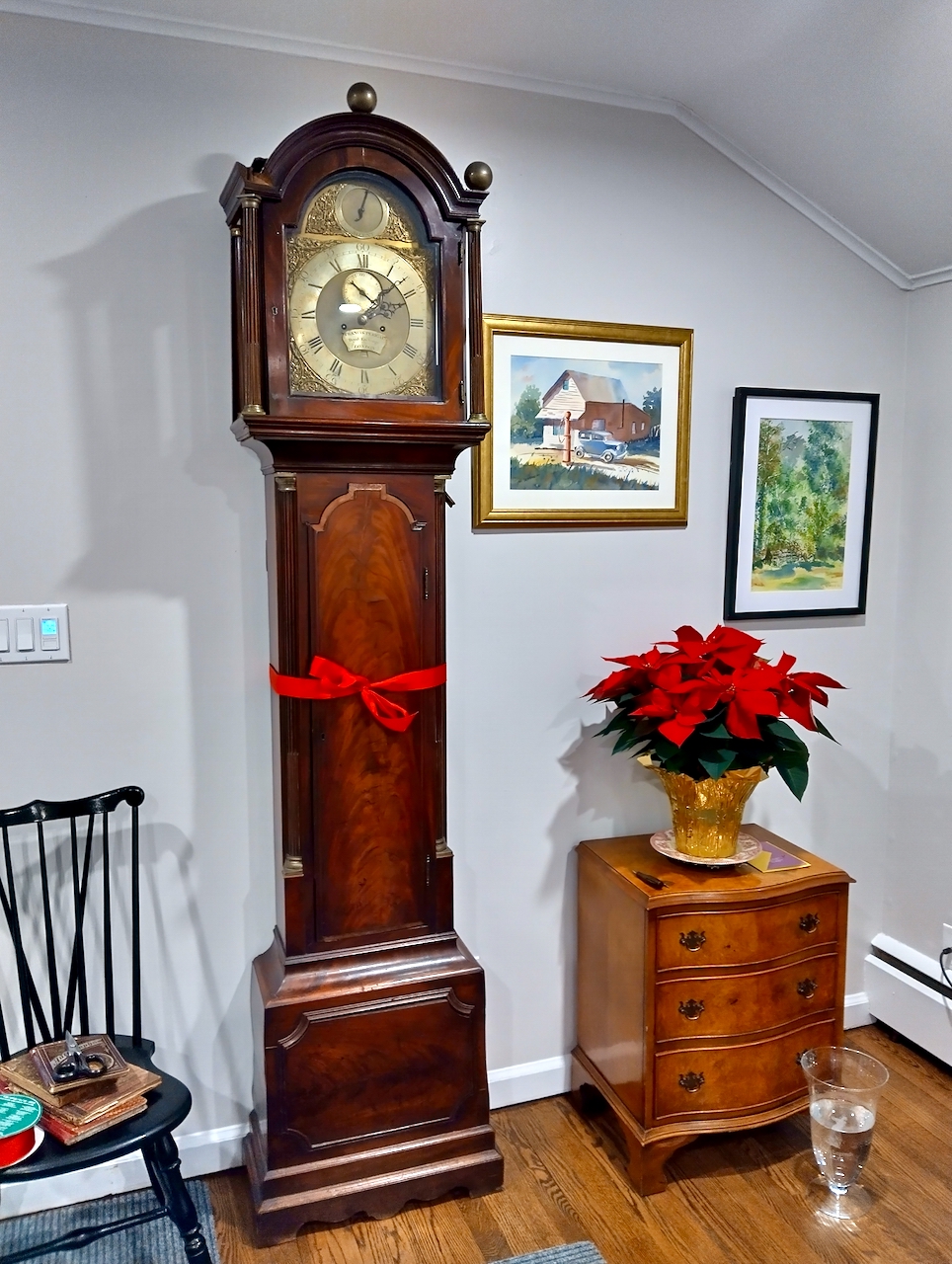
The longcase clock in Kay Yeomans’s living room. The red ribbon encircling the waist is not decorative—its quiet job is to keep the door from swinging open, compensating for a latch that no longer engages its worn mortise.
First Look: An Old Clock and the Weight of Responsibility
When I was first invited to look at the longcase clock, it was clear that this was not simply a piece of furniture in need of repair. It is an object with deep family history, tied closely to a place that has its own layered past.
The invitation came from my neighbor, Kay Yeomans. Kay is the curator of the Hopper-Goetschius Museum and a deeply knowledgeable student of the early settlement of northern New Jersey, particularly its Dutch, German, and English roots. Through years of hands-on involvement with historic buildings, objects, and archives, she has developed a careful and informed eye for material culture and the stories objects carry with them.
Kay asked whether I could offer advice about her family’s grandfather clock. Not about the clock’s movement—I have never restored a clock mechanism—but about the wooden structure itself: the case, the joints, and the damage that had become increasingly difficult to ignore.
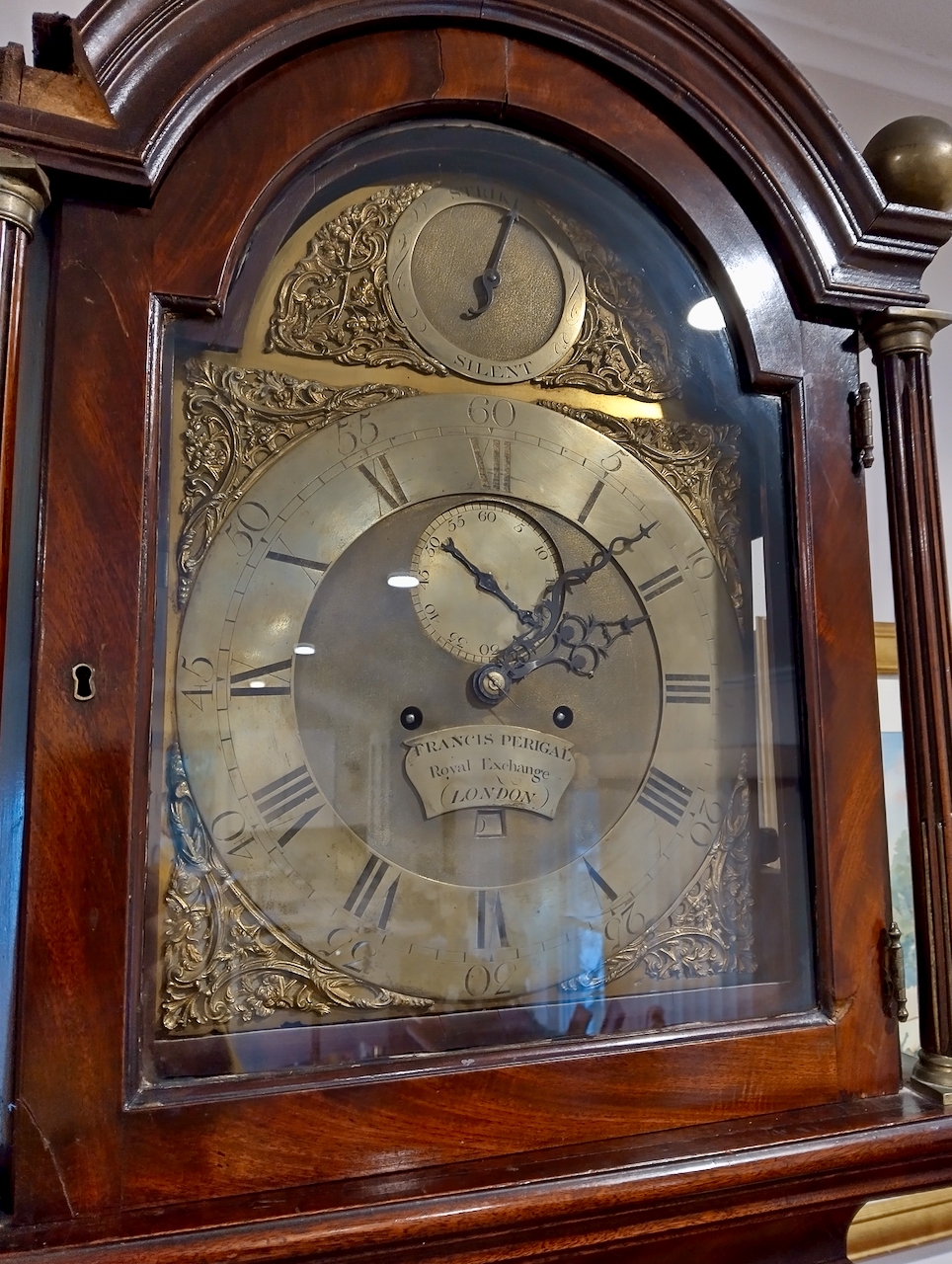
The hood and movement
The Clock and Its Path
The clock has been in Kay’s family for many decades. It was given to her father while he was working in England, where it was known to be operating at the time. Over the years, it traveled with the family to the United States and eventually came into Kay’s care around 1990.
From roughly 1990 until early 2023, the clock stood in the old mill building on the Yeomans family’s historic gristmill property in Upper Saddle River, New Jersey. The mill dates to around 1800 and was converted into a private residence in 1938–39. In January 2023, the clock was moved a short distance—from the mill building to Kay’s nearby house on the same property. The distance was minimal, but the consequences were not. Shortly afterward, structural failures in the case became apparent.
The movement is English, made of brass and engraved with the maker’s name. Its design is consistent with late-18th-century longcase clocks. Both the movement and the case were made in England, and the case was clearly constructed to house this specific mechanism.
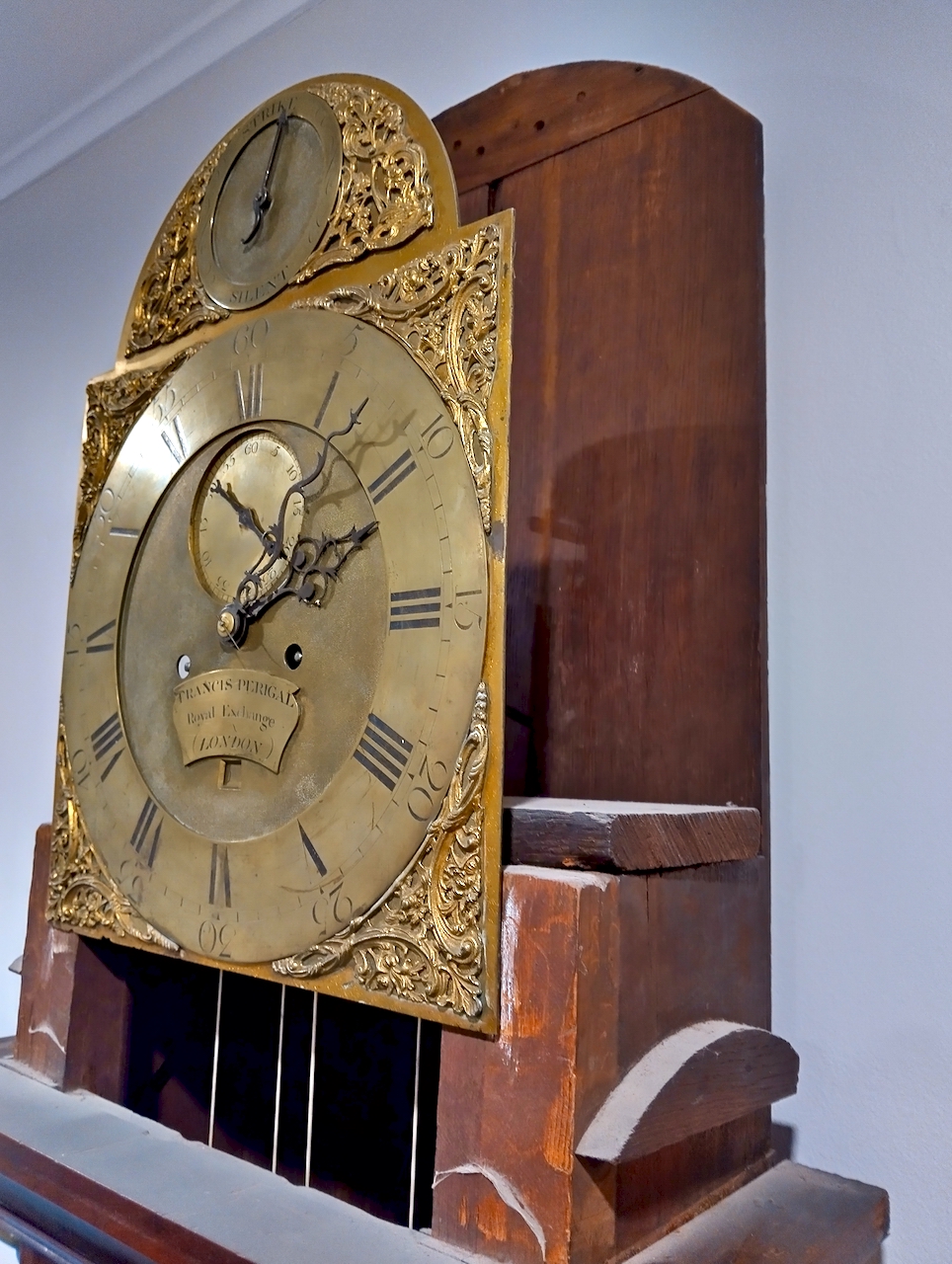
The clock movement revealed after the hood was slid forward and removed. The exposed mechanism underscores the clock’s English origin and the level of craft invested in its making.
A First Examination
The wooden structure of the clock is composed of three primary assemblies: the plinth (the base), the trunk (the tall central case that houses the weights and pendulum), and the hood, which slides over the top of the trunk and encloses the movement.
The hood is a U-shaped structure that slides into place, encircling the top of the trunk from the front and back. It is ornamented with applied classical columns. The capitals and bases of these columns are brass and are mechanically fastened—nailed—into the wooden framework beneath. The hood can be removed safely, and I took it off during inspection to reduce risk and to better understand the construction.
While examining the hood more closely, I was surprised by what I found on its left side. A frame-and-glass-panel assembly had partially failed, revealing how it had been constructed. Contrary to what one might expect in a piece of this age and apparent refinement, the joints were not mortise-and-tenon, nor tongue-and-groove. Instead, the frame members were simply butted together. The assembly relied not on interlocking joinery, but on the cumulative buildup of applied moldings above and around the frame to hold everything in place.
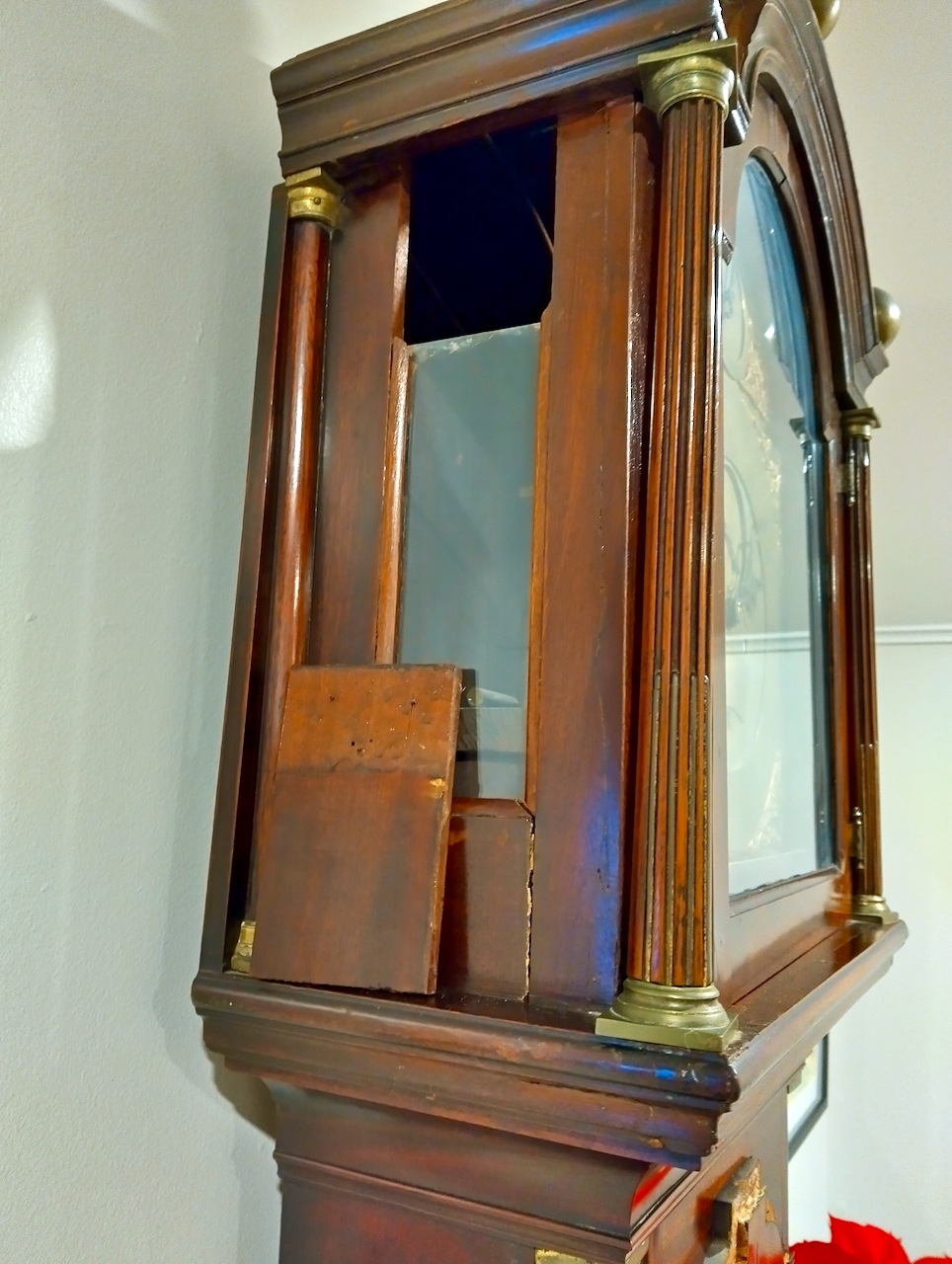
One side of the hood, built as a frame-and-panel assembly. The joint failure reveals a surprising construction choice: a simple butt-glued joint, reinforced only by applied molding, that nonetheless endured for more than two centuries.
It was an unexpected discovery. Many of us carry assumptions about historic workmanship—that older automatically means more robust or more mechanically sophisticated. Here, the structure depended as much on layering and glue as on joinery. It had held for centuries, but once movement and age finally caught up with it, there was very little redundancy left to prevent failure.
The Trunk Door
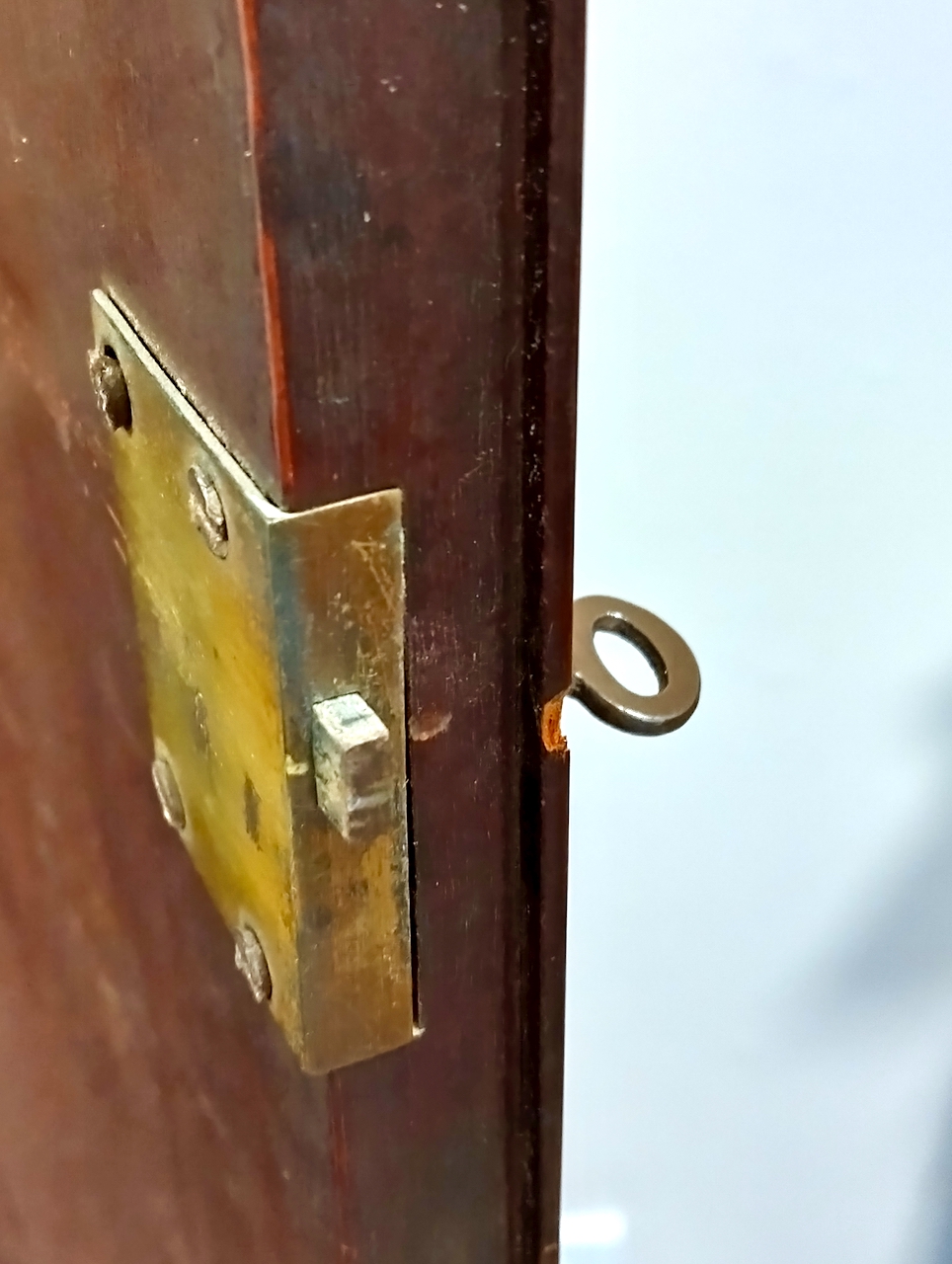
The trunk door is not glazed. It is framed and decorated with applied mahogany moldings, many of which have detached over time as the original animal-based hide glue gradually failed under cycles of humidity and dryness. During a second visit, we discovered that one of the original keys still operates the lock: the key turns, and the latch moves freely.
However, the door will not stay shut. The door has shrunk over time, increasing the gap between it and the trunk opening, and the mortise in the trunk frame that once received the latch has deteriorated to the point where it no longer provides meaningful purchase. Any functional repair here would require rebuilding that receiving mortise so the latch can once again engage securely and allow the door to close and lock as intended.
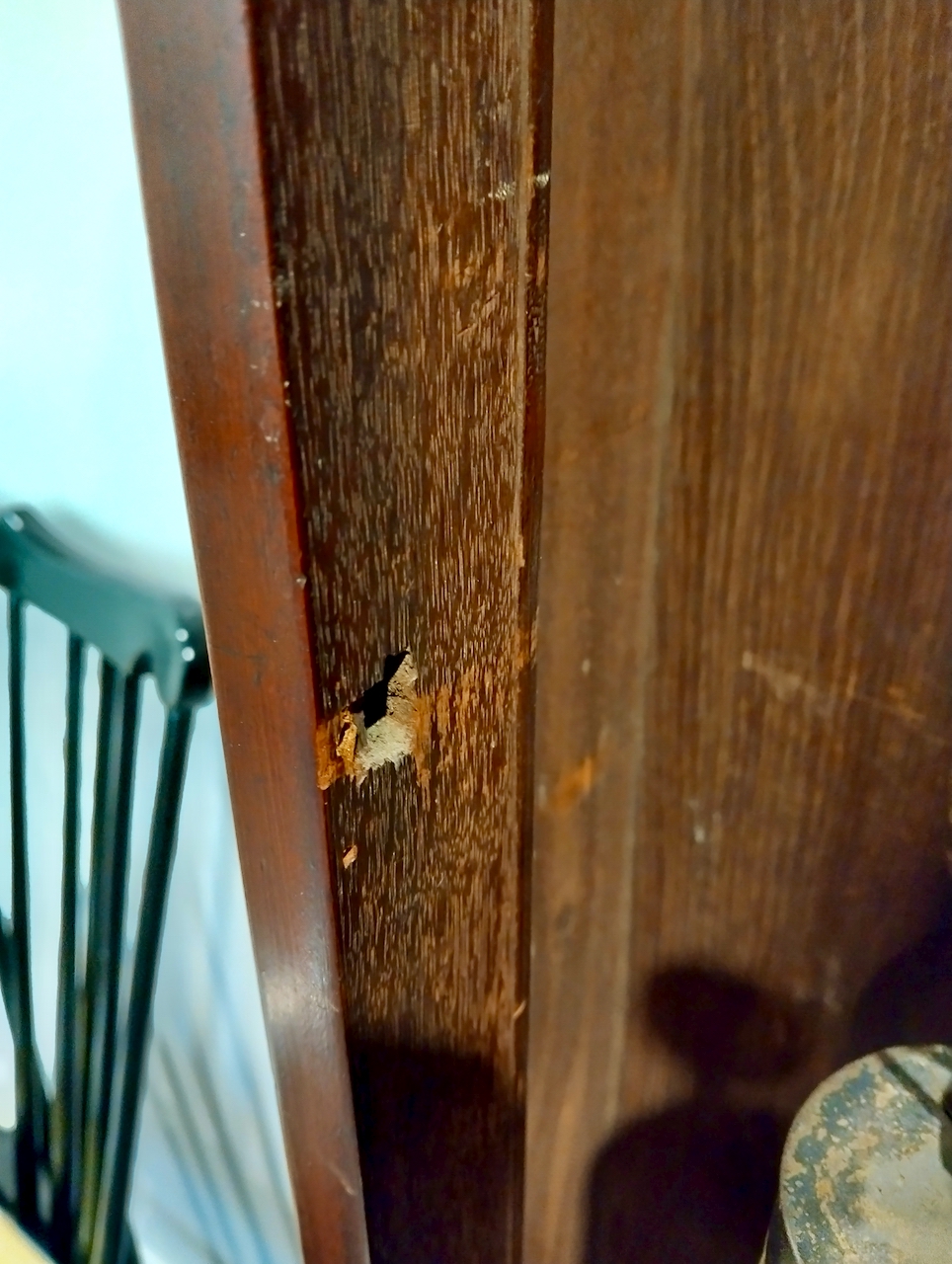
The deteriorated mortise in the trunk frame, where the door latch once engaged. Shrinkage of the door and loss of material in the mortise now prevent the door from locking.
The Plinth: Where Time Finally Spoke
The most serious structural issue lies in the plinth. It is constructed from multiple elements: two solid-wood side panels with veneer applied across their visible faces; a refined front frame-and-panel assembly with decorative veneer and moldings; and a simpler, utilitarian back structure composed of vertical boards that rise into the trunk above.
Bellow:
Interior view of the plinth, showing the grain orientation of the solid-wood panels beneath the veneer. The opposing grain directions help explain the long-term stresses that eventually compromised the glue joints.
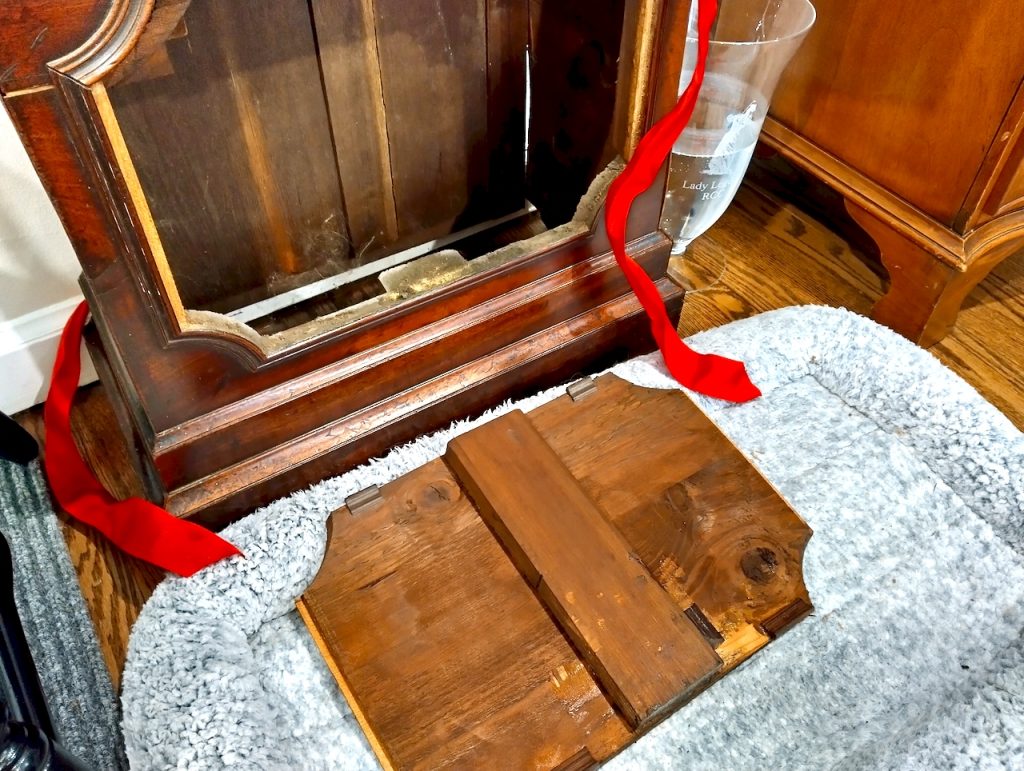
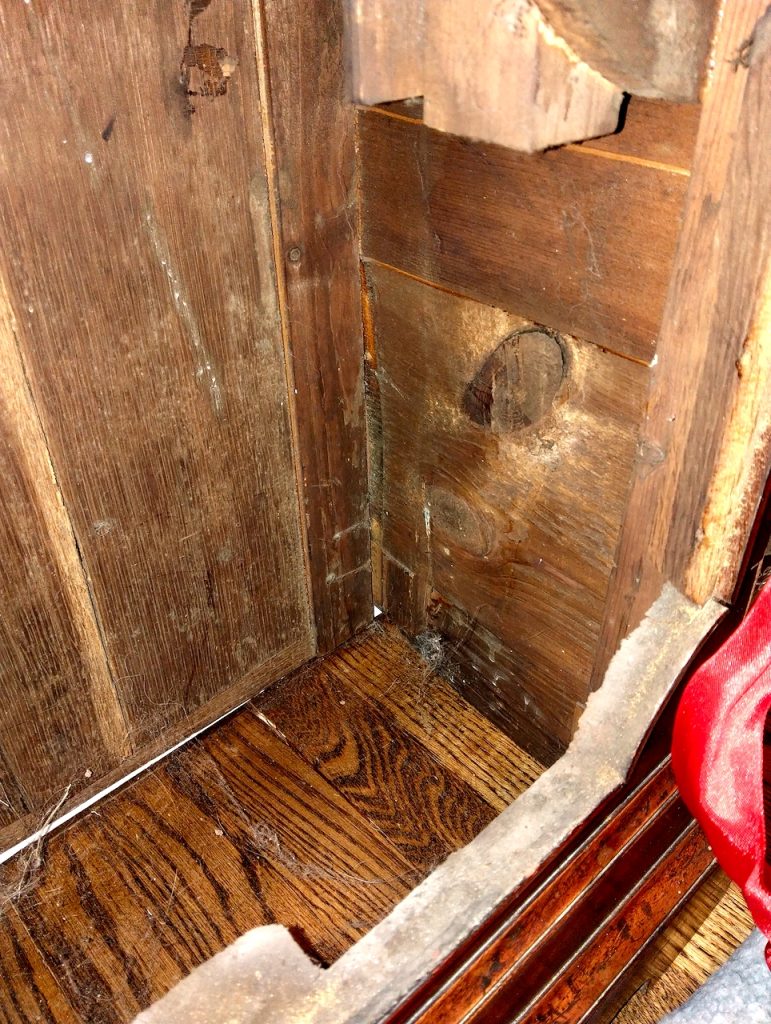
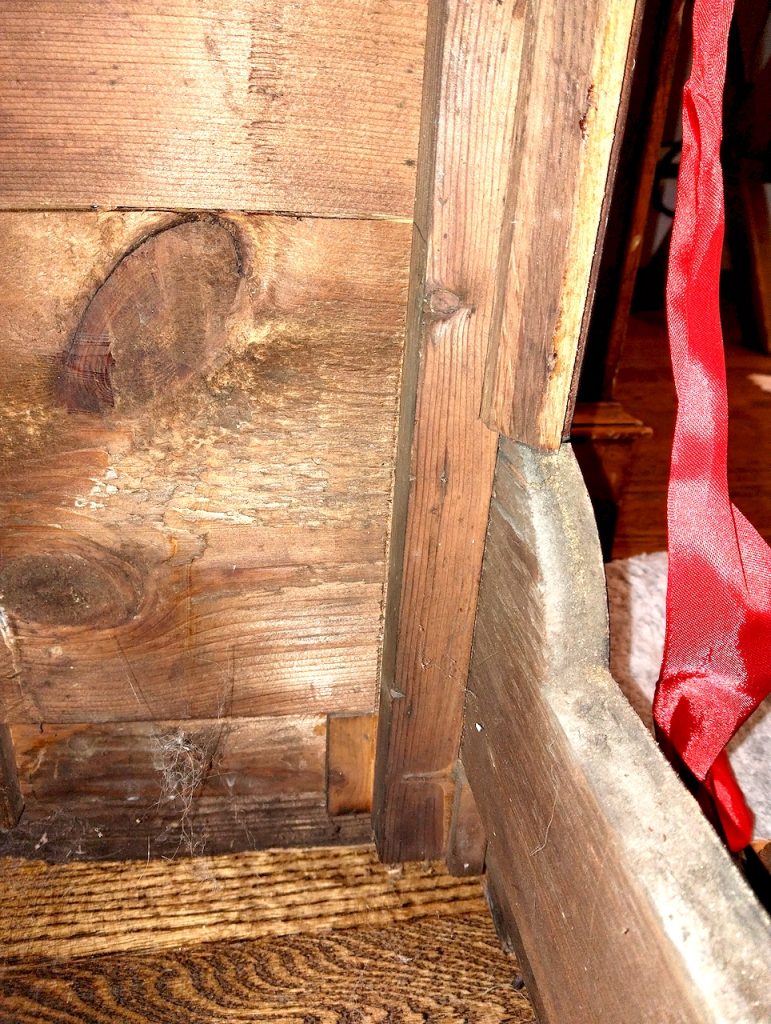
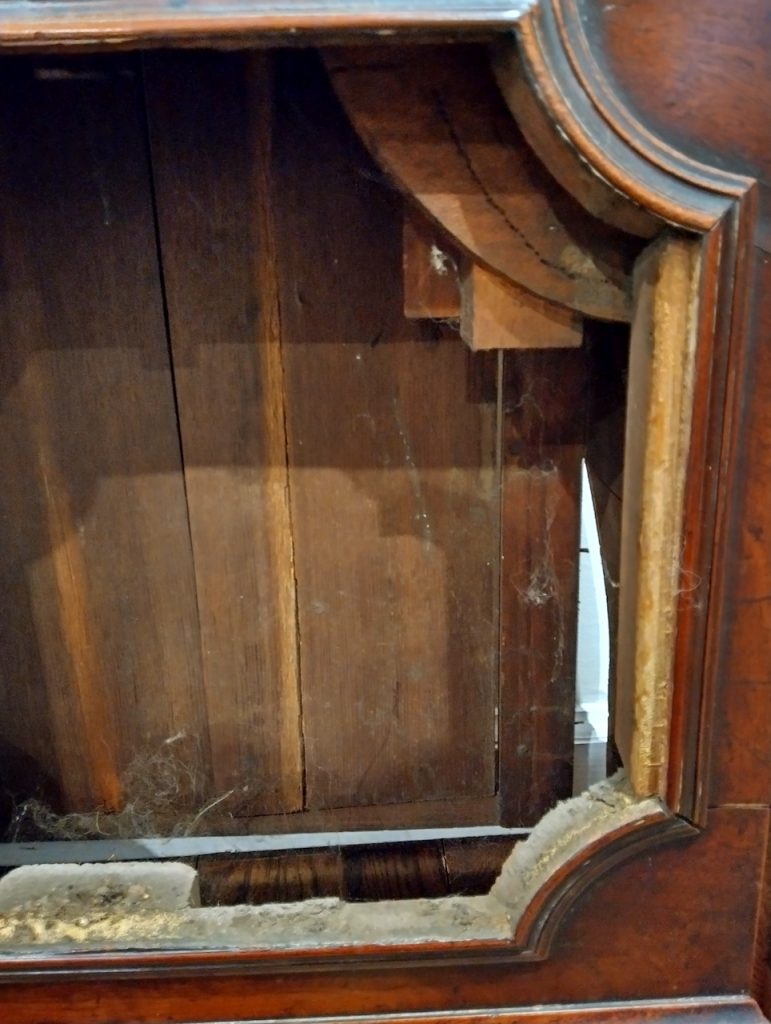
These elements are joined largely with long miter joints—some approaching twelve inches in length—and glued. What makes this construction particularly vulnerable is the orientation of the wood grain. The grain direction of the narrow side panels conflicts with that of the longer front element, creating opposing movement across the glue lines. From a contemporary woodworking perspective, this is an inherently unstable arrangement.
What is remarkable is not that one of these joints eventually failed, but that the structure survived intact for more than two centuries. Only during the most recent move did one of the long miter joints finally give way, allowing part of the plinth to flare outward while remaining partially attached.
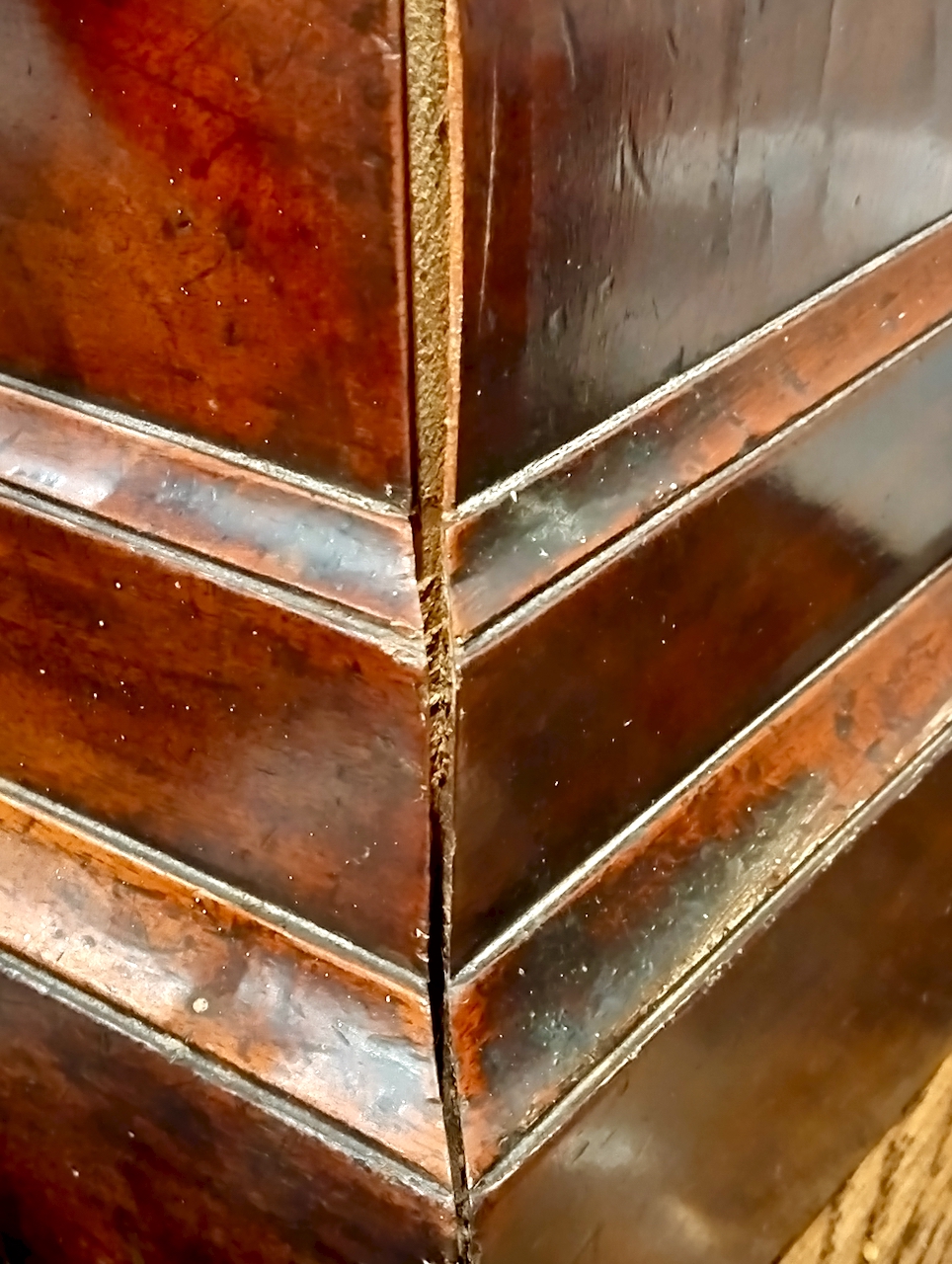
A failed miter joint at the corner of the plinth. The thick veneer conceals a solid-wood substrate whose movement over time placed the miter under increasing strain.
Standing Before Decisions
Nothing I observed suggested neglect or misuse. What I saw instead was the cumulative effect of time, material behavior, and a single moment of disruption, revealing stresses that had long been present.
At this point, the clock is not collapsing—but it is no longer structurally sound. Loose moldings, failed glue joints, a compromised door latch, and a partially separated plinth all point to the same reality: this is a moment that calls for care, restraint, and judgment.
Before tools are chosen or plans are made, there is a more fundamental question to answer—not how to fix the clock, but how to think about fixing it at all.
That question, and the dilemma it creates, is where part two begins.
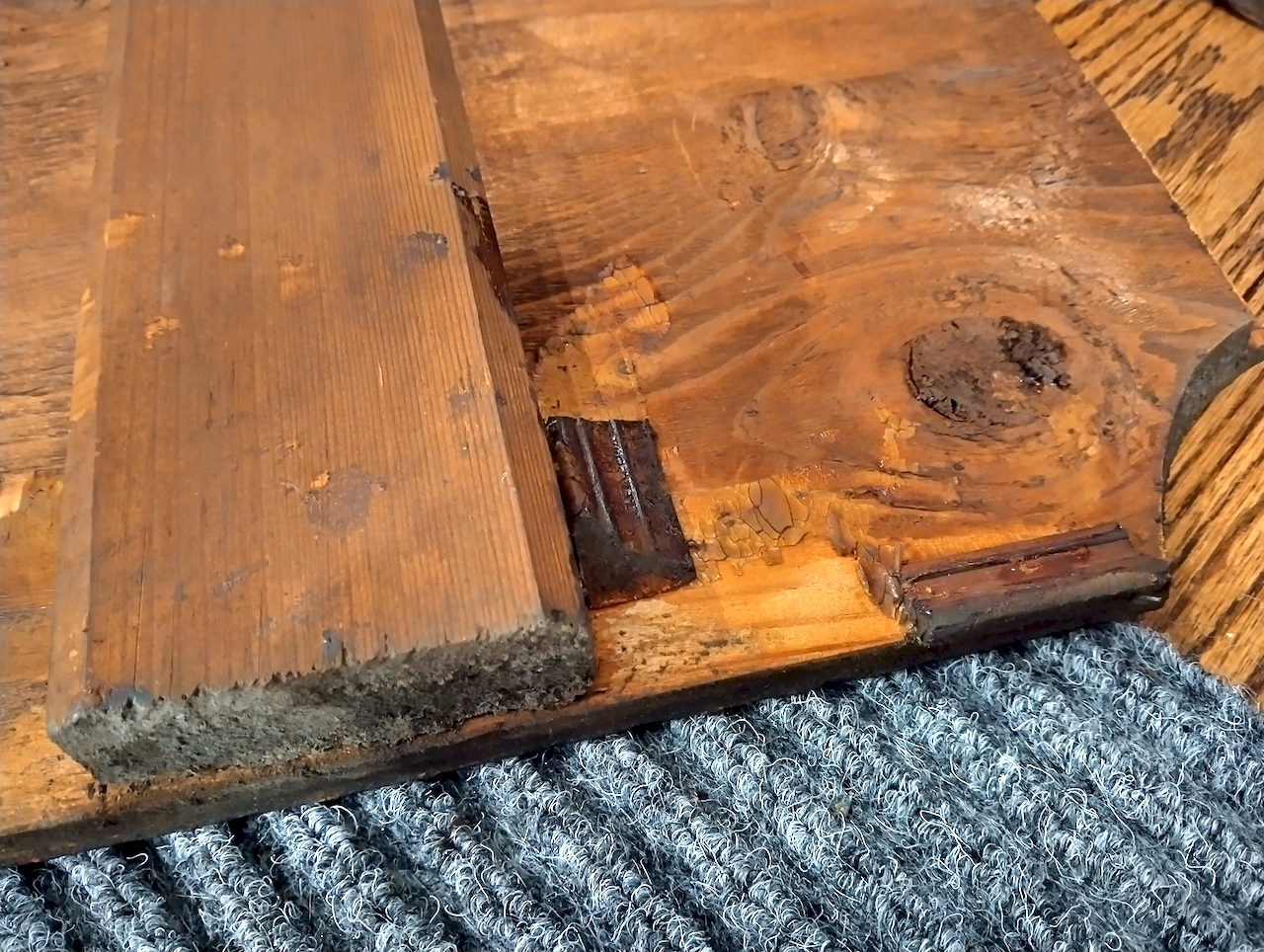
Interior construction detail: panels and frames reinforced with corner blocks fashioned from scrap molding, hide-glued in place—a practical reuse of offcuts rather than purpose-made blocks.