We may receive a commission when you use our affiliate links. However, this does not impact our recommendations.
 This week I was in the shop working on an upcoming magazine article. On the case back there are two dados that locate and hold the drawer dividers of the project. For me, that generally means I pick up my router and get busy. This time, because I needed two matching slots, I decided one would be router-cut and for the second I would use hand tools. Is one method better than the other?
For my router setup I needed a 5/8″-diameter, top-mount bearing router bit, my router and one of the most-used jigs in my shop, a square-platform jig; one of the “Dirt-simple Router Jigs from the November 2008 issue (#172).  I clamp the jig on the left side of my layout lines – do this when using any router jig because the tool rotation pushes in that direction – and set the depth of cut making sure the bearing is riding along the jig. I then make the cut. (One thing I forgot to do was to score or saw the beginning of the cut to prevent blow-out.) Overall, this process took about three minutes from start to finish.
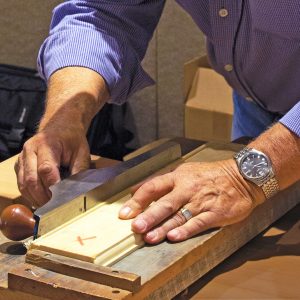
 To cut the dado using my hand tools, I began with my dovetail saw and cut the two sides of the dado. I went to final depth at the open end, and ran past the housed end in typical over-cut fashion – half-blind dovetail work has made over-cut lines perfectly acceptable to my woodworking mind. Chisels removed most of the waste. I used my chisel bevel down for some of the work and bevel up as I began to reach the final depth.
  The last step is to use a router plane to level the dado to its final depth. This entire process is described in more detail in the November 2013 issue (#207) in the “6-board Chest” article.
The hand-tool process took about 10 minutes give or take. (And there was the time spent taking photos for each of the processes – one for the power setup and six or so for the hand-tool work.)
In the end, I spent more time with the hand-tool process, but not by a significant amount. I worked harder cutting the dado by hand, but that’s not necessarily a bad thing. I think the dado cut by hand looks better, but that’s nothing anyone would see until the piece is trash or re-worked. Truth is, I didn’t discover that one method is better than the other. It’s just how you choose to work.
I did, however, discover a flaw in the justification that many hand-tool users suggest as to why they choose hand tools. For many hand-tool devotees, the main reason they give for selecting this process is that hand-tool usage is quiet. More quiet than when using power tools. In this technique, I disagree. My router cranked out high decibels for about 40 seconds, but every mallet whack to my chisel spiked the decibel meter into the stratosphere. And I lost count of the number of whacks taken.
So what is the answer? Simple. Choose your method, and get to work.