We may receive a commission when you use our affiliate links. However, this does not impact our recommendations.
I had hoped not to sound negative or snarky in a recent ww forum post about thin plate dovetail saws. The responses I received were mostly excoriating. When the drama regarding my word choice, and whether I should have posted publicly or privately was finished, the subject changed and no one got back to the point. Since then, several folks have blogged about thin plates saws, but none have touched on what I was trying to say.
By 2003, I had completed a full working set of Seaton Chest style saws. The saws I posted pictures of at WoodCentral were the control group. I made saws of varying shapes, sizes and plate thicknesses. I played with .015, and some thinner stock. The control group was initially secret. I started construction in 2001, using these saws for close to a year before anyone knew about them.
I shared what I learned about the control group (which generated a fair bit of attention) but either because I just didn’t think of it or because no one ever asked, I never talked about the experimental saws I made. See, I thought that the 18th c saw designs were superior to Disston’s. And I wanted to proove it. I still believe the changes 19th c saw makers made to their designs were based on cost cutting and the switch from a pro furniture market to a less skilled carpentry market.
Keep in mind, I was thinking of going into the saw making business. At that time, the only decent new western saws were dovetail saws made by IT/LN and those being made in Williamsburg. IIRC, CW was buying their long blades from England (which I wasn’t wholly impressed with). I knew then that if hand tool woodworking was to survive, we needed good quality rip saws. By the end of 2003, I was convinced no one in the world besides me was interested in 18th c reproduction hand saws so I abandoned my saw making ambitions altogether.
I returned to saw making in 2007. By that time, Mike Wenzloff was making beautiful Kenyon saws and I was curious about earlier designs. So I once again returned to the shop and began experimenting with the interaction between blade shapes and handle position and angle.
In my quest to make faster cutting saws, I experimented with thin saw plates. I tried to apply “thin plate technology” to the full range of Western style saws. Though it may not appear below, I really focused my attention on rip saws, spending a great deal of time trying unsuccessfully to hammer “tension” thin blades to make them stiffer. This is what I learned;
Tenon Saws
Tenon saws are sensitive to the depth of cut. I saw the corners out. So when I encounter architectural sized (read: wide) tenons, I need a fairly deep blade. And this proved to be the limiting factor for the plate thickness.
See, a pushed saw blade is like a column. Make the column too slender and it buckles. Stubborn as I was, I stuck with these saws (and still have some). To make the thin plate saws work, you have to either stabilize the column (with a spine very close to the teeth) or reduce the load on the column. Believe it or not, you can actually do the latter.
What I did was first reduce tooth size (which limits the length of kerf to some degree because the gullets fill with saw dust and then lift the saw out of the cut). Then I reduced rake. I never thought to add fleam. Mike Wenzloff does that with some of his saws. I have no doubt it’s an effective strategy. I just don’t think I could hand file 1 or 5 degrees or fleam.
If you are following me, adding rake, and increasing tooth pitch (tpi), make saws cut more slowly. A thin plate saw should cut faster since it removes less wood. But together, a thin saw with slower cutting teeth result in a saw with not necessarily stellar performance.
Dovetail/Drawer Saws
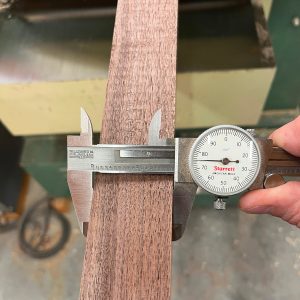
For DT saws, .015-.020 is fine. Below .015 is where the fireworks start. I made exactly one saw with a sub.015 plate and I hated it. I’m not sure how to get such a saw to function well. I limited the depth of cut, had a glued on machined slotted spine to ensure I had good pressure between the blade and the spine.
My thin blade got distracted by the rings in the QS Eastern White Pine I use for drawer sides. I wouldn’t even consider SYP or Oaks with such a saw. Part of the problem seemed to be the thinness of the stock. The rings would twist the blade sideways, the blade would vibrate, often cutting a wider kerf tan a thicker saw would. As a result, I was convinced not only was this not a faster cutting saw, it was a slower one. Pulling such a saw should solve the problem, but I’ve had some similar problems with my admittedly cheap Zeta dozuki (yes I have one). Lastly, cutting drawer DTs is not a place where I’m looking for speed improvements.
Carcass Saws
For carcass DTs, I do want a fast cutting saw. But for these joints, I find the use of a coping saw to be a significant time saver. Anything that prevents its use, in my opinion, can’t really be considered a time saver. I found making a long shallow bladed carcass saw was a good choice. If you are looking to make a saw faster, making it longer is the first obvious choice. This is the reason why folks made 8′ long pit saws.
I had some trouble filing really thin plates. Not sure how Japanese saw makers do it. Filing thin plates is the same as sawing thin boards. The board bends under the pressure from the saw teeth, then snaps back and you get vibration. The files I was using just didn’t have fine enough teeth I guess.
Rip Saws
I found some success with a thin plate (.032) rip saw. This, in my mind, was where an improvement in speed had the most potential to be helpful. I did a few things to make these saws work:
I made them shorter than normal. They are difficult to control at 26″, and much better behaved at 24″. I filed fairly small teeth (approx 10ppi) and added more rake than I usually prefer. For very hard, thin wood, they are nice to use. But are they really faster? Frankly, I doubt it. Part of the problem is their tooth geometry. Part of the problem is just their delicacy. I’ve since shared these saws with friends and students. Some students have found them unusable.
To be fair, it’s hard to measure the speed of a saw. In real world tests I conducted, the sharpest saw always won, typically regardless of its design. And this really shouldn’t come as any surprise to you. And I can typically change a saws teeth to get it to go faster. So much of the sawyer’s experience is governed by the filing of the saw’s teeth.
My advice (if you’re asking) is to try it before you buy it. And don’t assume that because a saw has a thinner plate and therefore removes less wood, it will be faster cutting. Saws are complicated tools. Thin plates might work best in super hard woods, rosewood, ebony, etc, and especially those that are fairly homogeneous.
Adam