We may receive a commission when you use our affiliate links. However, this does not impact our recommendations.

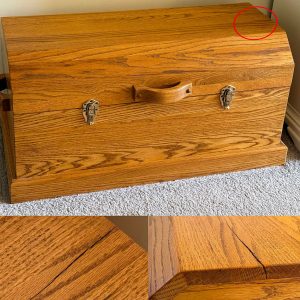
Next to my workbench at home, I keep an antique tool chest that has a tricky, sticky and unpredictable lock. Most days, I can open the chest with ease. I rotate the key. The cylinders turn. The lid lifts to reveal tools, hardware and supplies that I use every day.
But every so often, the lock refuses to work. I rotate the key. The cylinders turn. The lid sticks. I curse and then repeat the process until the lid opens. However, a couple times during the last decade, no amount of fiddling would open the chest. And instead of reaching for a wrecking bar, I’d just walk away and come back to the chest later on.
Some days, I get that same uncertain feeling in my chest whenever I get ready to flatten and join some boards that are particularly long, wide or wild. Today was one of those days as I set out to flatten the top of my work-in-progress: an English-style workbench. The section of benchtop that was on deck this afternoon was 22″ wide and 8′ long. It was reasonably flat, but it needed to be really flat to sit tight onto the base of the bench.
Some days, it doesn’t matter how skilled you are. Or how many times you’ve trued up a slab of wonky wood. Some days the wood wins and you go home with your tail between your legs.
The first challenge when dealing with wide and long panels is finding a place to work on them. With this section of the top, the answer was simple. I placed it on the base itself and pushed it against the heads of a couple screws that I placed into the holes that eventually will join the base to the top.
The ends were a little out of true and some quick work with a fore plane across the grain brought them into line with the center section of the top. A couple passes diagonally across the top with the fore plane got the surface flat enough to push against the fence of our powered jointer.
Senior Editor Glen Huey looked over as I was working the top and offered (sincerely, but with a twinkle in his eye) to put the benchtop in his truck and run it through his wide-belt sander in his shop at home.
I declined, saying that the exercise with the fore plane would allow me to justify drinking a second beer tonight after work. Glen smiled and nodded his head.
All was going well, but edge-jointing the top piece was another tricky piece of work. It’s another part of a project that can go wrong for no good reason. I jointed the edge. I jointed its mate and showed them to one another. I was shooting for a spring joint and I got one, but it was a little strong on one end of the top.
Undeterred, I straightened out the end with a few passes of a block plane. Within a few minutes the whole top was glued up and clamped with a tight seam all along the 8′ top.
I had earned an extra beer, and the tool chest didn’t win this round.