We may receive a commission when you use our affiliate links. However, this does not impact our recommendations.
Pegging through-mortise-and-tenon joints is an excellent way to reinforce the already strong joint.

Good dowels can be hard (if not impossible) to find, so when I need the right size and the right species, I make my own. It doesn’t take long, and the work is a nice relief from fussing with other details. I start with a straight-grained piece of scrap about 3″ long, and split off pieces with a chisel. All it takes is a good rap with a mallet after I put the chisel in place.

I start by aiming for about 3/8″-square blanks to make 1/4″ dowels. Sometimes the split will be off course, and the blank is made smaller by laying it down on the bench and continuing the splitting by placing a wide chisel on the wood and pressing down or tapping with a mallet. Essentially, this is riving lumber on a small scale. It doesn’t take long to get the hang of it, and it doesn’t matter if I lose a few in the process. Split material works much better than sawn for making these short lengths. The blank is stronger because the grain is continuous throughout the length.

When the blanks are close to the right size, I knock the corners off with the chisel or by whittling with a knife. I whittle down the end to make it easier to start in the holes in the dowel plate. The plate is just a 1/4″ thick piece of scrap steel with a series of holes drilled in it. The holes are in steps of 1/16″ and I didn’t bother trying to sharpen them. If they get dull I may take a flat file across the face to create a burr, but this works just fine. If that’s too simple for you, you can buy a fancy dowel plate or try to harden and hone the thing. To use it, I start with a large hole and pound the blank through. The first hole or two will knock the corners off, and the final hole will scrape the entire edge of the dowel.

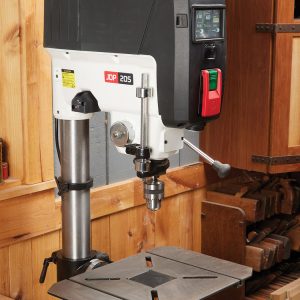
With a brad-point drill, I drill through the front edge and about 1″ into the tenon. I put a dab of glue in the hole, and drive the dowel in place. After the glue dries, I trim it flush with a saw, then pare it down flush with a chisel. A few swipes with a block plane and it’s finished.

That’s the how to do it part. But why go to that much trouble to reinforce a joint like that – where is it going to go?
I confess that I don’t have a good answer, except that I was copying an original detail that does make a statement about building for forever. But here’s how I usually explain it, “It’s just in case there’s a disturbance in the earth’s magnetic field that yanks us out of orbit and sends us toward the sun. On the way to oblivion it might get hot enough for all the glue to melt and for the wood to shrink enough to pull out. Other than that, I don’t think you need to do it.”

Put your pegging skills to the test with “Arts & Crafts Furniture Projects.”