We may receive a commission when you use our affiliate links. However, this does not impact our recommendations.

The only downside to using cut nails is they can split the work, especially when used near the ends of boards. While a properly sized pilot hole will usually prevent splits, there are times when the gnarly grain of the wood wants to split anyway.
Cut nails also will split your work if you use a nail size that is just too big for the boards at hand. And that was my problem today.
I’m building a nailed-together tool chest to create a manual for my students in two upcoming classes. The joints at the corners called for a 4d or 5d nail, but all I had on hand was 6d or 7d. Plus, one section of the pine boards had some crystallized sap, which tends to deflect nails and create splits.
The solution? Bar clamps.
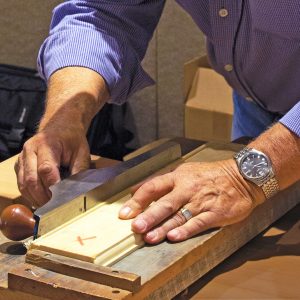
By clamping across the joint you greatly reduce the chance of the boards splitting when you nail them in. If you look at the photo above you will see two different clamping strategies at work.
To prevent splitting in the top board, concentrate the clamp pressure on the end grain of the top board. This is the strategy I use when I have big nails and little boards. I used this strategy with the clamp closest to me,
To prevent splitting in the bottom board (this was because of the sap), shift the pads down to press on the bottom boards. You still might get a split on the interior of the case, but that is preferable to a split on the outside. I used that strategy for the nail I’m driving in the photo.
The clamp simply reinforces the wood so it can endure the shock of the penetrating nail. You are fooling the board into thinking it is longer than it really is.
Try it. I think you’ll find it works quite well.
I’m a sure this is an old trick, but I don’t remember seeing it in any of my old books. I think I grabbed a clamp in desperation one day many years ago. And that’s probably how most tricks are discovered.
— Christopher Schwarz