We may receive a commission when you use our affiliate links. However, this does not impact our recommendations.

One of the few other people on this earth who understand my sickness affection for workbenches is Rob Giovannetti.
I met Rob at a Gallotapalooza event outside Chicago several years ago, and we’ve stayed in contact via e-mail. Rob , and I say this in the most affectionate manner possible , has a workbench problem.
He’s built eight workbenches (all different styles) and taught two classes about it. You might remember is Rob-O workbench from 2006 that I featured here on the blog.
Rob is about to embark on another bench-building adventure real soon. His next bench I have named the “Manufactured Wood Smurf Bench.” Long story. It’s going to be cool when it’s done, I’m sure.
In the meantime, Rob sent me the following list of the top 10 things he’s learned about workbenches. It’s an interesting list.
– Christopher Schwarz
1. Benches don’t need to made of hardwood. I’ve made several benches from hard maple, but the ones I’ve made from Borg Douglas fir worked just as well and were usually easier to make.
2. I have a love/hate relationship with tail vises. I’ve tried every vise you could think of as an end vise, including none, and I keep coming back to the tail vise. I can’t fully explain why this is, but it just is.
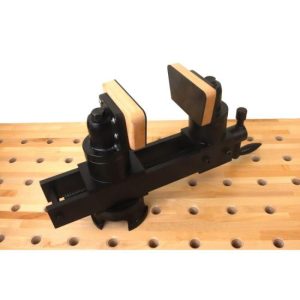
3. The shoulder vise is the easiest face vise to use, but the most time consuming and complicated to build. Go figure. If you like to dovetail and hand cut your tenons, I recommend this as the vise of choice. A close second would be a twin-screw.
4. Square dogs aren’t worth the effort. This may sound like laziness, but aside from a sense of “tradition,” there is no reason for me to have square dogs. Round holes are quicker and easier to make, and they hold just as well. Plus, the 3/4″ holes can be used for a wide variety of other purposes.
5. If one row of dogs is good, one is even better. In other words, I’ve not encountered a single situation where multiple rows of dogs was a benefit; and I have a bench with four rows of ’em.
6. Tool trays are for people who are clutter-aholics. I am one of them. Even with my tools hanging above my bench, I’m much more likely to throw a tool in the tray than put it back where it belongs. I’ve found more organized people don’t use them.
7. A good bench NEEDS a board jack. Whether the base is flush with the front edge of the top or not, a sliding deadman is a must-have accessory.
8. The only reasons I can figure for having endcaps on a bench are either 1) they support a tool tray at the rear of the bench, or 2) they support a vise of some kind on one, or both, ends of the bench. I don’t believe an endcap has the rigidity to keep a top from cupping.
9. If I had a dedicated gluing/assembly table, my bench would have no finish on it at all. Even with dogs, wood on wood is the best grip you can get. Even one coat of oil can make a benchtop overly slippery.
10. None of these things apply if you can make masterwork furniture on a sheet of plywood on sawhorses. Some of the best work I’ve seen has come from the simplest of assembly tables; but if you do a lot of hand tool work, I think the aforementioned points will help make building furniture much easier.
Please note I didn’t mention plywood as a bench material. Truth be told, I don’t know much about building benches from man-made materials. I do, however, have an idea of building a top from 3″ wide ripped Baltic birch and face gluing them together to form a core. Laminate with hardwood veneer or hardboard on the top and bottom, and add equal thickness solid wood skirting around the edges, I think it would be quite suitable for pounding on without much flex.
– Rob Giovannetti