We may receive a commission when you use our affiliate links. However, this does not impact our recommendations.
 The city council candidate was screaming at me through her phone as I sat hunched over my desk in the newspaper’s newsroom.
“How about I pull down my pants and you come and watch me go to the bathroom?” she screamed. “You’d like that wouldn’t you?”
This impolite invitation was issued after I inquired about a long string of tax troubles the candidate had suffered during the last few years. Unpaid taxes. Lawsuits. State charges. And etc. It’s all part of doing your job as a journalist. When people run for public office, you look up what the public record has to say about them. And you let them explain their side of the story, even if it involves a toilet.
After years of this sort of work, you get used to people hating your guts. You do what you think is the right thing. You try to be fair to everyone. You end up being despised. But, if you do your job correctly, something else also happens: People always – always – return your phone calls.
This might sound crazy, but I have found a similar game goes on with furniture design. There is the easy road: reproductions of beautiful pieces of furniture that have been lauded in books and magazines. These pieces are similar to feature stories you might read in the newspaper about a famous actor who is starring in a new movie and how his role challenged him as a person and a professional and caused him to grow in his soul region. Yawn.
I think reproductions of classic pieces are a good place to start as a designer. They teach you proportion, joinery and a lot of other lessons about what goes into a great piece of furniture. And if this sort of thing makes you happy, then feel free to continue down this path until you croak.
But there is a weird world of furniture forms out there that you won’t find in museums, coffee table books or magazines. There are forms that have disappeared for centuries for some reason. Pieces that were eclipsed by new technology. Movements that were never written about by scholars.
They are out there. And if you will let your freak flag fly on occasion, they are a hoot to build.
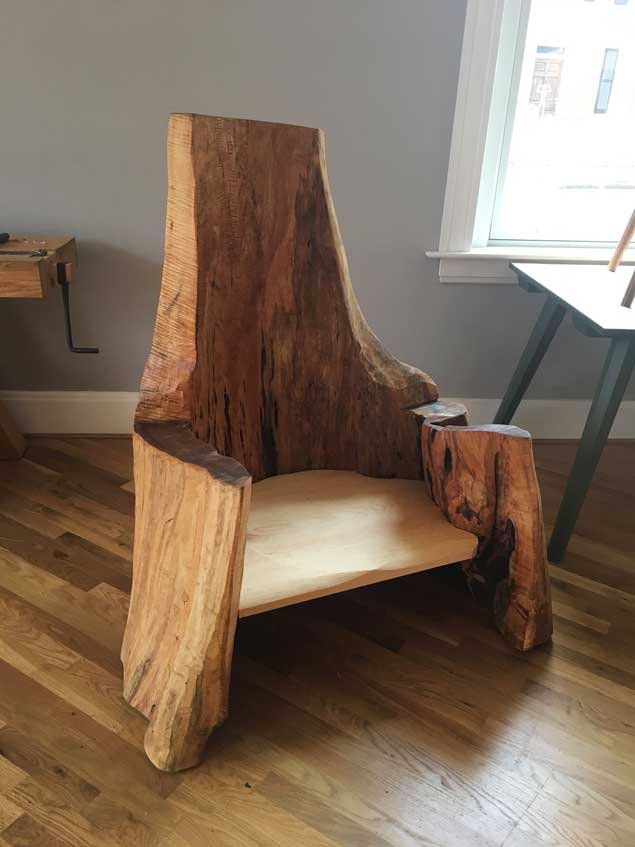
During the last couple months I’ve written about the crazy dugout chair shown above (it’s almost done – not quite). The response has been similar to the screaming earful I got from that city council candidate. A few samples: It’s the ugliest thing in the history of furniture. It’s butt-ugly. What the he&^ are you doing? You usually make nice stuff; this is not one of those things.
Dugout chairs are an important part of the furniture record, though they are rarely written about and poorly understood. They are a vernacular form that sprouts from a simple idea: Even a rotting tree has a use. And it’s importance is directly related to the cultural significance of the idea of a chair (wonder where the expression “chairman” comes from?).
The act of building this chair resulted in far more than turning a tree into an unusual chair. It opened up a door in my head that embraces axes, chainsaws and angle grinders as tools for fine furniture. And once opened, that door cannot be shut, even if there’s a screaming politician on the other side sitting on the toilet.
— Christopher Schwarz