We may receive a commission when you use our affiliate links. However, this does not impact our recommendations.

One of the great things about handwork is that 90° is not the most critical angle. While absolute 90° is a holy setting on machinery, 87° or 93° is just as easy to cut with a handsaw, plane or chisel.
And so sometimes hand-tool users (myself included) denigrate absolute 90° as something reserved for beginners, Arts & Crafts enthusiasts and machinists.
After years of working by both hand and machine, I have a somewhat balanced view. Gravity is our friend and foe in the workshop. Drop a chisel (or 12” jointer) off a building and it will travel at a perfect 90° to the ground every time. Clearly, 90° cannot be ignored.
The trick is to understand when 90° has to be obeyed and how to do it. Both of these tasks are difficult and mushy.
When you cut mortise walls and tenon cheeks, there are times you can undercut your surfaces and end up with a serviceable joint, but having 90° surfaces is always always better. Same with dovetails. While the floors of your tailboard and pinboard can be undercut, the superior joint has dead 90° surfaces on the baselines.
Bottom line: When I’m in a hurry, I’ll undercut a joint by a degree or two to ensure things will go together. Chances are that an undercut joint will outlast me with no problem (undercut joints have survived hundreds of years). But when I’m calm, focused and intent on doing my best work, I strive for the perfect 90°.
The question then is how does one do this? By training yourself to see and feel 90°. This takes some time and conscious effort but pays off. For me, it involved adding a brief step to every handwork operation – chiseling, planing, boring, sawing.
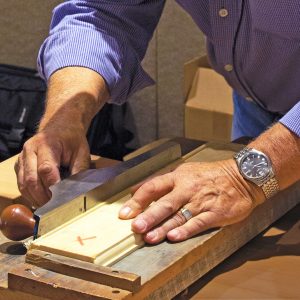
When chopping, for example, I place my chisel’s edge on the work, adjust its handle so I have a clear strike and raise the mallet. Before bringing down the mallet, I eye the angle between the work and the back of the chisel intently and ask: Is it 90°? It’s just one moment of complete focus on one question. If the answer is yes, I strike the handle. If not, I take a breath and adjust the tool and ask the question again.
I do the same thing when sawing, planing and boring.
When sawing, I examine the angle between the sawplate and work.

I’ve added lines that show the 90° I’m looking for.

When planing, I actually examine the far edge of the surface I’m planing and the angles created by the adjacent faces. Are the corners dead 90°? If so, the surface being planed is square to its adjacent faces. If not, the surface is not 90° to its adjacent faces. I need to shift the plane left or right to correct the surface.
When boring, I look in two axes – both have to be 90° before I proceed.
This extra second of concentration and confirmation seems like it might slow you down. I have found the opposite is true. I am much less likely to take a wrong stroke that has to be corrected somehow. As a wise man once said: Go slower; it’s faster.
— Christopher Schwarz