We may receive a commission when you use our affiliate links. However, this does not impact our recommendations.

Reader Jon Pile writes about the parallel guide bar in a leg vise: “The parallel guide bar is, in my humble opinion, a cruel joke perpretrated by some historical prankster. I have been using an angled leg vise for a couple years now, and removing the guide bar was the first modification.

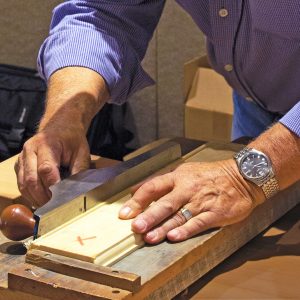
Instead, grab a piece of maple, cut it down to 1″ x 2″ x 3″, and let it dangle on the bench leg with a foot of butcher’s twine. When you open the jaws of the vise, just turn the block so the appropriate side acts as a standoff.
Wider stuff? Find a wider piece of scrap. Skinny stuff? Swing the block out of the way altogether.
Infinitely variable. Simple and bulletproof , and I can reach down and adjust my “parallel guide,” left-handed, without looking at it.
Please, I’m begging, don’t let the swiss-cheese-looking parallel guide insanity continue any further!
As for thickness (of the leg vise’s jaw), I started with a 2×6 of white oak and found that it still flexed too much! I doubled up on thickness , it’s 3-1/4″ thick now , and finally I’m happy. With this setup, I have applied enough torque to shear off the 3/4″ maple pin that held my bench top to the legs. Also easily repaired and improved.”
I tried the Pile Block (patent applied for) in my leg vise today. I made it exactly as he described and tied it through a holdfast hole in the leg that I use when dovetailing.
 The block works as advertised, which is no surprise. Levers and physics work as advertised. But I’m going to need to develop some muscle memory with the block before I rip out my parallel guide. The nice thing about the parallel guide is that I work in stock that is 5/8″, 3/4″ and 7/8″ thick.
So for the most part, I never move the pin in my parallel guide. It stays in the first hole and can clamp the usual stuff. (By the way, that sweet-spot hole in my guide is Ã?½” from the inside of the vise jaw).
A few other details: I wondered if the block would be handy with an angled leg vise (which is what is on my new English Workbench). With that bench, the parallel guide prevents the jaw from spinning when you crank the vise’s handle. Jon responded to that by saying that his leg vise was angled, and that he merely had the foot of the jaw resting on the floor, which kept it from spinning.
 I think the real sexy solution to the parallel guide is St. Peter’s Cross, a French invention that (apparently) revolutionized the leg vise. Even the British raved about St. Peter.