We may receive a commission when you use our affiliate links. However, this does not impact our recommendations.

Thanks to a book I’m writing on campaign furniture, I’ve installed more brass hardware in the last two years than in my first 18 years of woodworking.
As a result, I have become quite particular about how I install screws for hinges, pulls, corner protectors, hasps, locksets and so on. I’ve revisited a lot of old techniques and tried a lot of different ways of getting brass screws seated perfectly vertical without shifting the hardware in the slightest.
If your hardware shifts, that’s a significant problem with campaign furniture because most of the hardware is installed in shallow recesses. If the hardware moves a fraction of a millimeter, the remainder of the brass might not seat in its mortise.
It is a lot like installing 70 or so hinges in an afternoon.
Now, if you are satisfied with the way you install your hardware, stop reading right now. I’m not trying to change anyone’s mind about how they install hardware – I’m just trying to present an alternative to the way I was first taught to install brass.

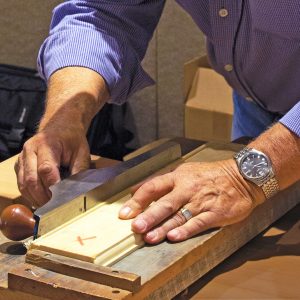
And that technique? Vix bits (shown above). Sometimes called “self-centering hinge bits.” I know many professionals live by these bits, but I’ve never liked them. I think the spring in the bit is too stiff, and the drill bits are liable to snap when you press the drill down to plunge. (Yes, I’ve tried several brands.)
I prefer a more manual process. It’s slower, but it gives me more control.
The most important tool is a spring-loaded hinge center punch. I’ve tried two brands: the Stanley and the Starrett No. 819. I vastly prefer the Starrett because it works with only one hand. You can hold the hardware right where you want it and then press the Starrett into the countersink and get it perfectly vertical with the other. You press the center punch down, loading the spring. Then the spring fires, punching the hole for your screw.
The Stanley looks like the Starrett, but it doesn’t “fire” the punch. So it’s a two-handed tool. One hand to hold the punch and the other to hit the plunger with a little hammer (yes, I know you can use finger pressure alone, but it doesn’t work for crap in hard woods).

After punching the centered hole, I drill the pilot hole with an eggbeater drill. This old drill (a $10 eBay find), allows me to control the exact depth of the hole and to gently increase the diameter a tad if need be.
To install the screw I rub the threads with paraffin and drive the screw with a screwdriver with a ground tip – like the ones that gunsmiths use. I like the Grace USA drivers, which I have written about before, but you can make your own on the grinder – or buy ground bits from a gun store, such as Brownell’s.
— Christopher Schwarz