We may receive a commission when you use our affiliate links. However, this does not impact our recommendations.

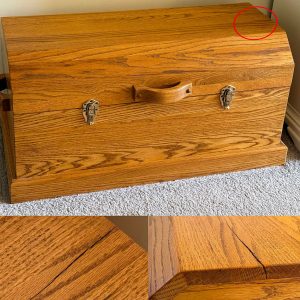
In response to a recent post about edge banding panels, a reader asked how I’d made the grain on a panel’s door run continuously around the corner and through to the cabinet’s side. (Above) The grain in question is striking, which makes this treatment so effective.
The technique is ridiculously simple – so simple that some readers would come up with the idea themselves, then think “that can’t possibly be it; it’s too elementary.”
But some good ideas really are that elementary.
Here’s my technique for wrapping the grain around a veneered panel’s edge.
Start by cutting your workpiece close to its finished dimensions, and mark the face near the edge you want to wrap. I used a chalk “V” because in this example I was using walnut composite veneer for a bathroom vanity, and the chalk shows up better than pencil.

Cut a strip from the panel that’s a hair over the panel’s thickness. I use a Forrest Duraline blade that makes a fine cut in veneered materials without tearing the grain.

Now rip the veneer off the substrate so you can apply it to the edge. Don’t try to put the veneered edge on the “good” side of the blade, as you normally would; it’s far too thin to rip safely. Instead, set the fence from the other edge of the piece you just cut off the panel, adjusting it so that the thickness of the veneer, or the thickness of the veneer plus just a tad of the substrate behind it, will be sliced off. In some cases it’s helpful to have that tiny bit of extra material provided by the substrate, not only because the extra thickness can make the veneer stiffer, but because the substrate adds structural integrity to a thin piece of cross-grain veneer that’s otherwise quite prone to breakage.
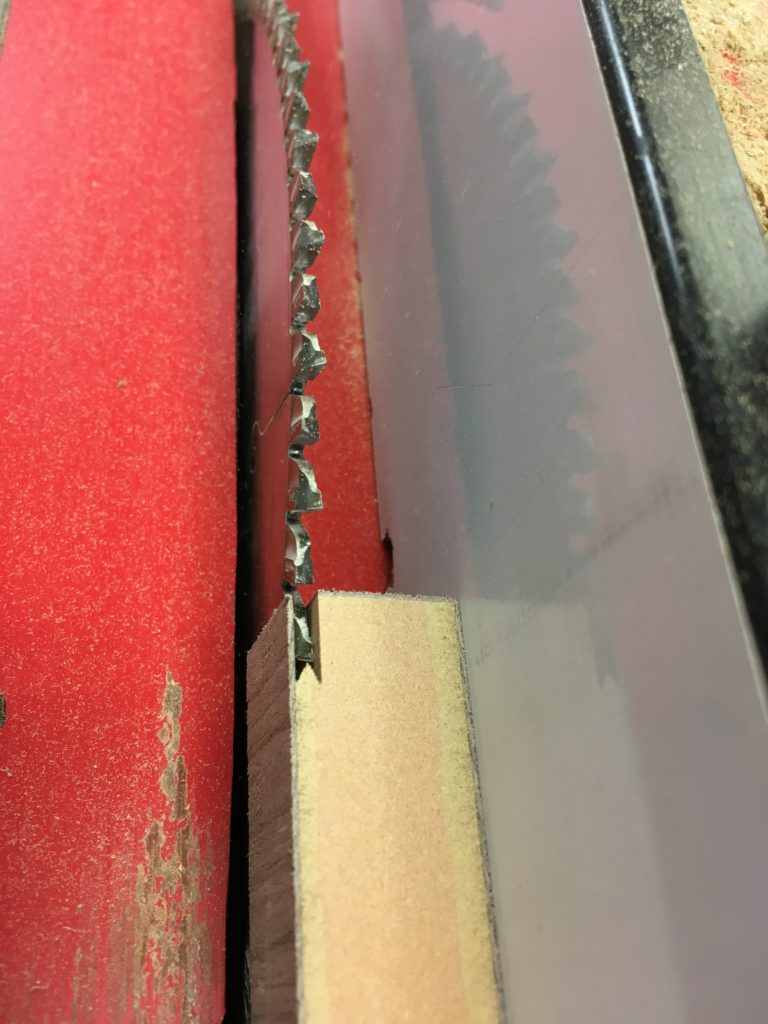
In this case, I sliced off the veneer and avoided the substrate. This is risky because the cross-grain veneer is thin and prone to breakage, but when the color of the substrate is such a contrast to that of the veneer, as in this case, it will interrupt the flow of the grain if you try to keep any of it intact.

Now spread a layer of glue on the edge …
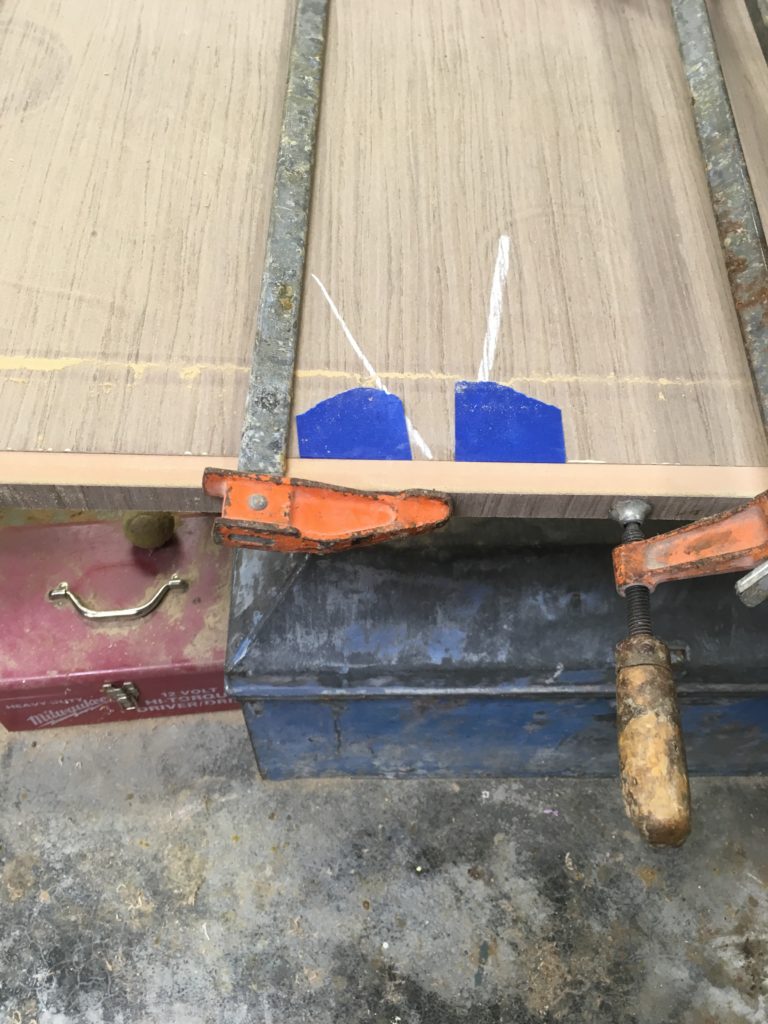
… and set the veneer in place. I use blue tape to hold the veneer in position while I apply a caul and clamps. Be sure the veneer is covering the entire edge of your panel and has not slipped down below the panel’s face. You’ll also need to use enough clamps to hold the veneer in tight contact with the panel’s edge until the glue has dried. And do be sure to avoid gluing the caul to your workpiece.

Due to the saw blade’s kerf, the grain does not flow seamlessly around the corner. The flow will vary depending on the type of veneer you use. But even with imperfect continuity, this is a slick detail that shows you’re paying attention. As with the image at the top of this post, you can use this technique to great effect, running the grain from one element of a cabinet to the next; all you need is to think the pattern through before you start cutting — and of course, to cut with care.