We may receive a commission when you use our affiliate links. However, this does not impact our recommendations.

About a decade ago, my boss Steve Shanesy told me something about design that knocked me flat. When he was a struggling custom furniture maker, he took some time off to do something that few people do.
Create a new style of furniture.
That is one of the most ambitious personal projects I could imagine. I wonder if there has there been a new style of furniture created in my lifetime. Does James Krenov’s work constitute a new style? Sam Maloof? George Nakashima? I don’t know the answer to this question, but I do know how one mouth-breather of a woodworker (me) goes about it.

And because I never tire of hearing how other people design pieces, I thought I’d share with you the convoluted path I’m taking this week to make a simple thing for our fall 2008 issue.
I like old furniture , anything from Ancient Egypt to World War II interests me greatly. So when I set out to build something I hit the books to look at as many examples of furniture and decorative objects from that period as I can. In this case, we decided to build an 18th-century wall cabinet for the fall issue, so I cracked open all my books from Wallace Nutting, particularly “A Furniture Treasury.” This out-of-print book is available in many forms and is fairly inexpensive. I paid $20 for my two-volume set at Half-Price Books.
I might not look at wall cabinets when I scan these books. I look at lots of casework pieces and their proportions, mouldings and the arrangement of the components, such rails and stiles from doors.
When I’m saturated (a few trips through the treasury will do that), I’ll start sketching. It’s not formal. I just draw without regard to perfectly straight lines or dimensions. I sketch in the car while waiting for the kids to finish track practice. Or in the few minutes of peace I get between the bedtimes of the two kids. I sketch things that I’m sure won’t work just to give them their day in ink.

The more examples I draw, the better the chance I’ll hit something I really like. I don’t use the Golden Section or any other mathematical formula. It’s all gut.
Then I fire up a CAD program on my laptop and try to turn the sketches into something that can be built and has some dimensions that make sense , a dining table that’s 30″ high, for example.
While In CAD I’ll make a few variations that take advantage of the cut-and-paste power of the program. I’ll move the drawers and doors around. Add a cupholder. With this wall cabinet I tried it with two doors (like the Nutting original), one door, then a door with a drawer.
Then I show the CAD drawings to others and ask them which ones they like. Why they like it isn’t as important , though I always ask. Maddy, my 12-year-old, liked the two-door version of this cabinet because of the symmetry and that you could display two contrasting pieces of pottery behind the glass panes. Katy, the 8-year-old, liked the drawer because it could be used to “hold little things.” Lucy, my wife, declined to put a dog in that fight.
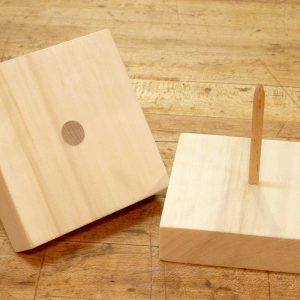
Next stop: If I have time, I’ll knock together a prototype in poplar to see if it looks awkward. Prototyping always pays off in two ways: I make small adjustments that improve the design, and I’ll typically keep the prototype for our family.