We may receive a commission when you use our affiliate links. However, this does not impact our recommendations.

At some point in my early 20s I stopped improving as a guitar player. No matter how much I practiced or played out in bands, I couldn’t crawl to the next level of skill.
I needed lessons, guidance, a push or something else. Or perhaps, I thought at the time, that was simply the best I was physically capable of: good, but certainly not great.
I never found out which was true. Our firstborn came along, so long nights of loud band practice and playing in bars became my past tense.
I also used to wonder if I’d hit a similar wall with my woodworking. Since my early 20s, the craft has consumed most of my life. I work in the shop 30 to 40 hours a week. I read everything I can get my hands on. I design and sketch in my idle time.
But I’ve never made the great leap to “period furniture maker.” Whether you like it or not, 18th-century high-style furniture represents the apogee of furniture craft in Western civilization. Any Westerner who loves woodworking should eventually take on the challenge and build a bombe chest, carve Newport shells, construct a Chippendale side chair and learn to inlay bellflowers.
While some of these skills are interesting to me – I do some carving, turning and veneering – I have zero desire to attempt these pieces. I recognize and respect the skill and dedication it takes to build high-style period furniture. But the stuff just doesn’t quicken my pulse. Constructing it would be an empty exercise in narcissism.
And that’s exactly where I was stuck about five years ago. Here’s how I dug myself out.
I threw myself into the furniture I love: vernacular pieces, Asian pieces, pieces from the Middle Ages, Welsh stick chairs and Danish modern. (It’s a weird mix, I know.) I sussed out the common threads that bind those interests. And that’s where I found the design language that has guided me for the last five years.
One of the common threads among those furniture styles is an emphasis on form instead of ornament. So I have (obviously) focused on perfecting and refining my forms, but I’ve also been doing something else. And that is what has saved me from despair.
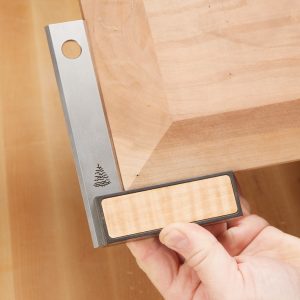
Briefly put: I’ve been raising the overall level of precision and detail in my work. A few examples from my work this morning: tighter tolerances, crisper corners, more daring through-mortises and an even better surface finish. To be honest, these changes are not noticeable to most people. And making these changes has slowed me down in many cases.
But they are important to me. So much so that I don’t charge customers for the extra time it takes to build a chair or a bench. I just eat the expense as the cost of the lesson.
This morning as I hammered home a wedge on a tricky glue-up, I took extra care to see that it plunged into the mortise exactly as much as all the other wedges around it. It’s a tiny detail, but one that took practice, a few failures and some skill to do.
Will anyone notice? I doubt it. But I’ve decided to focus my efforts to strive to be a Keith Richards instead of a Yngwie Malmsteen.
— Christopher Schwarz