We may receive a commission when you use our affiliate links. However, this does not impact our recommendations.
 It was probably 25 years ago that I heard Tage Frid explain how simple it was to hand cut dovetail joints. “After all” he said, “all you’re doing is cutting to a line. What could be simpler than that?” My first reaction was anger. My experience had been that it was a lot harder than that.
 But the thought stuck with me, and I chewed on it long enough that I finally was able to digest it. I came to believe that this was indeed the truth. If I can reduce the most complex joint to simple lines, locate the lines where I want them, and figure out how to cut to them, then I can make just about anything. What brought this to mind was a recent discussion on the Yahoo! Greene and Greene group about our recent article on the Gamble entry table drawers. The question was how were these joints originally made, and how could you make them without the router jig used by the author.
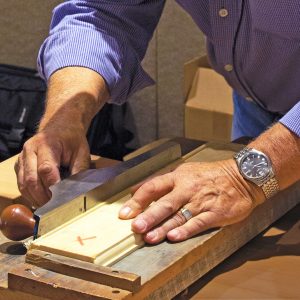
 I headed out to the shop to duplicate the joints using the table saw rather than the router table. In the photo above, I’m using my adjustable square to set the baseline for the finger joints. One thing I try to do is to minimize the amount of measuring, calculating and marking that I do. This speeds up the work, and it eliminates many chances for error. I set the end of the square’s rule as shown, then set the sliding head 1/8″ above the top of the board.
I have 2 long pieces, and 2 short ones. I’m going to mill the joints in pairs, so I only need to mark the ends of one short piece and one long one. After marking these lines, I lay out the fingers on both ends of one of the long pieces. I’ll wait until the joints are cut on the long pieces to lay out the matching parts of the short pieces.
 From this point on, I don’t need to measure anything, and I don’t need to think about numbers, I’m just lining things up to the few pencil lines I’ve made.
Over at the table saw, I put a piece of 3/4″ thick plywood next to the blade, and put the end of one of the marked pieces on it. By sighting from the side of the saw, I raise the blade until a tooth just meets the line when the blade is at top dead center. By rotating the blade (by hand with the saw unplugged) it’s easy to find top dead center-that’s the spot where the tooth wil start to fall away from the pencil line.
The piece of plywood is destined to become the base plate of a jig I’ll attach to the miter gauge of the saw. By tunning the jig through the saw blade, I’ll establish precisely where the kerf of the blade will be as I make my cuts.
 The other part of the jig is a scrap of cherry. Any hardwood will do, as long as it’s straight. It’s attached to the plywood with some glue and wood screws. The dimensions aren’t critical; it needs to be long enough to reach from the end of the miter gauge to a few inches to the right of the blade, tall enough to let me hold the work firmly to the back piece, and wide enough to give me room to line up the layout lines to the saw kerf.
After screwing the 2 pieces together, it is attached to the miter gauge with a couple of screws. When it’s all together, I turn on the saw and push the jig through the blade. This is a quick and easy way to safely and accurately line up the work to the blade. I can cut to either side of my pencil line, or split it if I want to.
 I marked the waste portions of the joint with some scribbled pencil lines to avoid confusion about what to cut and what to leave. You have to look close, but my pencil line indicating the edge of the joint is placed on the left edge of the kerf (left from my point of view, it’s the right side as the camera sees it.
I have both pieces clamped together so that I can cut them both at the same time. If I had a bunch of these to do, or if I were nervous about holding the work steady, I would attach a stop to the jig, or clamp the work to the back of the jig. Once I’m happy with where I have the work, and confident about keeping it in place, I can turn on the saw and make the first cut.
This is working close to the saw blade, but the work is securely held to the jig, and there is room to hold the work to the back of the jig. The saw kerf in the jig indicates the path of the blade, so I make sure my hands are in a safe position before making a cut.
With the jig firmly attached to the miter gauge, it can’t slip side-to-side, and the danger of anything kicking back is minimal.
I’m leaning over the blade here to line things up, but when I make the cut, I tip my head back and off to the side so that I’m not directly behind the blade.
If it makes you nervous to hold the work to the jig with your hands, clamp the work to the jig, and move your hands to the outer edges of the jig as you make the cut. Push the work forward until it passes the top of the sawblade, then pull it straight back until the front edge of the jig is well away from the blade. Reposition the work to make your next cut. I make the cuts on the edges to begin with.
 Once the edges of the joints are established, I nibble away the waste in between by making repeated cuts. After this, I take the just cut pieces to my bench, and clamp them in the vise to clean up the bottom edges of the fingers. Depending on the geometry of the table saw blade, this surface can be wavy, and it’s OK to leave thin fingers of wood in between the cuts. They will snap right off, and you can smooth the surface with a rasp, file, or coarse sandpaper stuck to a scrap of wood.
I’m using a planemaker’s float to do this. It’s an interesting tool, with rows of teeth going across the blade. From the edge it looks like a saw, and in use it works like one. The best results come when you let the tool do the work, letting it “float” across the surface rather than trying to push it down.
 With the first half of the joint completed, I clamp one end of one of the short pieces to one of the long ones to mark the second half for cutting. I don’t have to mark the baseline; that will come from the setting of the saw. I only need to mark out the edges, and mark the areas to be removed.
Then it’s back to the table saw and the cuts are made in the same way-line up an edge, make a cut. Line up the opposite edge, make the cut, then nibble away the waste in between.
The one difference is that for the second part of the joint, I want to make the cut so that I am saving all of the pencil line. If I cut into the pencil lines then the joints will be too loose. If I leave space beside the pencil lines, the joints will be too tight. Finger joints like these don’t n eed to be incredibly tight. You should be able to s lide them together with hand pressure.
If you do need to make an adjustment to loosen them up, a stroke or two with the plane float, or rasp on the sides of the fingers will do the trick.
 This is the assembled joint, right off the saw. The only hand work needed to get to this point was to clean up the bottoms of the recesses in between the fingers. Of course, being a Greene & Greene detail, there is still a lot of work to be done; holes need to be made for screws and square pegs in between the fingers, and all of those crisp, square corners need to be rounded off.
The point of all this is that the skills we need to do good work aren’t that many, and they aren’t that complicated. This elements of this joint are after all, just cutting to a line.
Often what holds me back is my own thinking, and the tendency to make things much more complicated than they really are. If I think of a joint like this as something really difficult that requires a lot of fancy equipment and skills I don’t have, I won’t be able to make it.
But if I think of it as nothing more than cutting to a line a bunch of times, it’s within reach. If I can remember to cut on the right side of the line.