We may receive a commission when you use our affiliate links. However, this does not impact our recommendations.

This summer I have made two changes to my Roubo-style workbench that I built in 2005 that have made the bench even more effective and easy to use.
First up, a real-deal antique French holdfast, sent to me by a colleague in France. Clearly blacksmith made, this holdfast is sized somewhere between the monster holdfast that blacksmith Peter Ross built for my daughter’s workbench and the typical modern style.
It works like crazy, even in a full 4”-thick benchtop. The sucker sets itself so easily that I have to release it on occasion when I didn’t mean for it to cinch down.

Here are some statistics: The holdfast weighs in at 5 lbs. 6 oz. The shaft is 17” long. The neck has a 7” reach from the centerpoint of the shaft. The pad is 1/4” thick x 1-9/16” wide x 1-7/8” long.
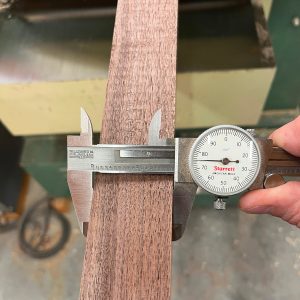
Why does it work so well? My guess is that it’s the shaft. It measures about .985” in diameter all along its length. It just barely slides into a 1”-diameter hole. But slide it does. This close fit is what wedges the holdfast in place when struck with a mallet.

This fall I’ll take the holdfast to Ross in North Carolina and have him take a look. Perhaps he can be persuaded to make some for other woodworkers – it would certainly require less material and effort than the full-on beast he made for me as per Andre Roubo’s dimensions.

The other big change is that I toothed the entire surface of my benchtop. I got the idea years ago from Patrick Edwards, who has been toothing his bench for years and has evidence that it was common practice.
Several woodworkers I have talked to have told me that toothing the benchtop makes it grippier.
Intrigued, I tried it.
The result? It does help prevent your boards from sliding side-to-side or pivoting when planing them against a planing stop. It doesn’t feel any different to me when pushing the work forward against a stop.
But that’s a good thing. Most of the time I don’t want my boards pivoting when I plane them against a single-point stop. And the toothing seems like it helps that.

Sure, the toothed surface doesn’t look as nice as a finished tabletop or swanky bench. But I’ve never been in the “beautiful bench” crowd. Toothing the top of my 8’ bench took about 15 minutes with a toothing plane, which is typically used for roughing up a surface for traditional hammered veneer. After roughing up the benchtop I brushed it off and went to work – no finish.
As always, we shall see how these two traditional touches to my bench fare in the coming months. I’m optimistic.
— Christopher Schwarz