We may receive a commission when you use our affiliate links. However, this does not impact our recommendations.

When I first built my Roubo-style workbench, I wanted to see if I could work without an end vise. So for the first year or so I used my planing stop, holdfasts, battens and geometry to steady my work as I planed it.
But I got tired of the whack-whack, shuffle-shuffle necessary whenever I needed to plane across the grain of panels (called traversing) or plane diagonally on any size board.
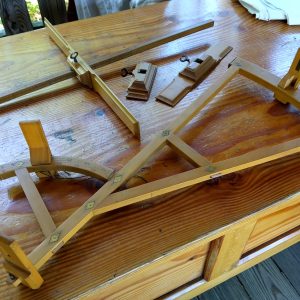
So I started futzing around with wagon vises, which I first spotted in an early 20th-century French tool catalog. My first attempt was rather “agricultural” , let’s call it the “Early Cletus Period.” I built one using a veneer press screw, some wooden runners, chewing gum and a fancy French-style escutcheon plate.
I soon left the Cletacious period and designed an evolved wagon vise that used a bigger acme vise screw, which is on the English-style workbench in my book on workbenches.
But today I am walking fully upright, leaving my sloping forehead ways behind me. My Roubo workbench is now outfitted with the ultimate wagon vise by Benchcrafted.
In the interest of full disclosure, I paid full price for this vise and spent my own money , Le Roubo is my workbench. (The prospect of my company moving all my stuff out of the office is probably one of the reasons I’ve never been downsized. It would take weeks.)
The Benchcrafted is a nice piece of work. After installing dozens of poorly made vises (and a few good ones), I was impressed to see how well cast and machined every component was as I took it out of its box.
The vise’s installation instructions are thorough, well-illustrated and to-the-point. Benchcrafted also includes full-size templates that make laying out all your cuts and holes a snap.
For me, installing the Benchcrafted was a retrofit. So it was a little more involved than if you were installing this vise on a new bench under construction. The vise requires a cavernous cavity on the underside of your benchtop to house all its finely machined guts. So I spent some serious time hogging out waste with a router and a mortise chisel.

Then you need a beefy end cap on your bench to hold the vise screw. My cap is about 3″ thick and is lag-bolted to the benchtop. A new bench could easily incorporate dovetails into the design or some sort of breadboard construction.
With the cavity and end cap complete, the rest of the job was precision boring and fitting. Use a drill press to install the vise screw. The templates and the hardware are made to tolerances that are too tight to hit with a brace and bit.
And use a router to install the runners. The runners guide the sliding dog. If the runners are out of line, the vise will bind up. Precision is paramount.
Then it’s just a matter of fitting the sliding wooden dog and lining the interior faces of the jaws with leather (I used some scraps I found at Michael’s craft store and yellow glue).
How does it work? Like a dream. The dog moves quickly and smoothly back and forth. And the wheel on the end doesn’t interfere with the soles of my planes (like on the Cletacious vise). It is, without a doubt, completely worth the $350.
And though my co-workers laugh when I say it, I think this is the last end vise for the Roubo.
– Christopher Schwarz