We may receive a commission when you use our affiliate links. However, this does not impact our recommendations.

I sharpen a curve on the cutting edge of all my bench planes and block planes. The curve prevents the corners of the iron from leaving behind “plane tracks” – those ugly little steps. But there are many other benefits to using a curved iron. Here’s one more:
It can make your mortise-and-tenon joinery tighter.
This might sound improbable, but it’s something I achieve with every mortise-and-tenon joint in my shop. Here’s how it works. Like dovetails, the mortise-and-tenon joint is incredibly strong even if you cut it poorly. Cosmetic gaps are just that – cosmetic.
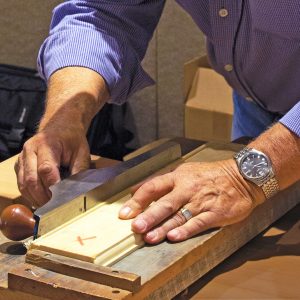
But many of us don’t like gaps. To remove gaps with a mortise-and-tenon joint you need to close up the point where the tenon’s face shoulder meets its mate. Here’s where your curved iron comes into play. Take a look at the photo above. It’s a leg with multiple mortises.
As you can see, I’m planing the leg so the weakest part of the curve is touching the area that will show the most. If I shift the plane to the left, I could make a huge mistake. Here’s a sketch that explains it:

On the left is what happens when the curved part of the iron carves out the middle of the leg and allows the tenon’s shoulder to seat tightly against the show surface of the leg. On the right is what happens if I shift the plane to the left even a little bit.
(Note that the curves above are exaggerated.)
Yes, this approach encourages a gap on the inside of the assembly, but I’m happy with that trade-off.
— Christopher Schwarz