We may receive a commission when you use our affiliate links. However, this does not impact our recommendations.

Both of these nicks were caused by splinters this past weekend.
Splinters are par for the course when working with wood. But when you work in a shop where your hands provide the precision, a bad splinter can end your workday prematurely or just make your work less enoyable. So I’d just like to add a few thoughts that may help you prevent and treat these minor injuries.

Gloves are your first line of defense:
I keep a pair of soft calf skin gloves in my shop for moving lumber. Wearing them for these tasks is a no brainer. I was raised thinking that gloves were only for the weak. My brother Steve once boasted that he spent a week laying cinderblock and at the end of the week his hands were as tough as baseball gloves. But I don’t lay cinderblock. I’m a cabinetmaker. And even when I work full time at it, my hands are never like that. When the job calls for it, I don my gloves without a second thought.
Moisture barrier:
In addition to barrier protection, I think keeping my hands soft helps prevent splinters. When my hands become dry and chapped, they become splinter magnets. I keep a bottle of hand lotion next to the sink where I wash up. I try to moisturize after each hand washing. I avoid abrasive or strong soaps if I don’t need them. And I wear gloves to protect my hands from the jobs that require detergents to wash up afterward. My fingers get black when sharpening my tools or scraping walnut. Nitrile or latex gloves offer good protection with little or no inconvenience. They are inexpensive, reusable, and work great. Their use saves me from having to scrub off stuff I don’t want to transfer to my work or tools.
Treating splinters:
My goal when removing splinters is to do it in such a way that I don’t make a small injury worse. I keep a good, sharp pair of tweezers in my shop’s first aid kit. What? You don’t have a shop first aid kit? Well use Woodworker’s Safety Week as your excuse to make yourself a small dovetailed box to hold these essential woodworking tools. Have fun with this. Inlay a bloodwood red cross for instance. Or decorate it with bent-over nails.

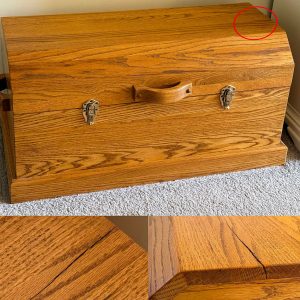
I made this miniature of a PA Dutch blanket chest for my wife, but it would make an excellent shop first aid kit.
Add to it a good magnifying glass and some alcohol swabs. When you need to dig out a deep splinter, first clean the tweezers with the alcohol. Once the splinter is out, be sure to wash the area well (soap and water at least). Use the magnifying glass to make sure you got all of it.
Keep it clean:
In most cases, I remove my splinters, wash my hands and go back to work. But if the splinter drew blood, I treat it like a cut. No it’s not a serious wound. Yes this sounds excessive. But you want to protect it so you can go on working without turning it into something worse. If you get dirt or chemicals in there, even a lowly splinter can snowball into a painful infection. I like to apply vaseline to small wounds as I think the vaseline helps keep the wound clean. It’s a barrier. Bandaids alone don’t seem to be much help. When it’s a fingertip or joint, which are difficult to bandage, maybe it’s time to break out a pair of gloves. If the latex is too thin and the calfskin gloves too clumsy, try a pair of these.
Related: The Best Shop Towels
Elsewhere on the internet, folks are discussing what to package a severed digit in for the trip to the emergency room. We’re talking about splinters. I don’t want to mislead you into making light of injuries in your hand tool shop. I just wanted to start Woodworker’s Safety week by seriously considering the most common woodworking injury.
Adam
P.S. Give me your thoughts about what you think belongs in your hand tool shop’s first aid kit.