We may receive a commission when you use our affiliate links. However, this does not impact our recommendations.
| Early American Life magazine honored me by including me in the 2008 Directory of Traditional American Craftsmen. I also snuck past the judges in 2005. The name of the directory has changed since then. Before it was top 200 traditional craftsmen. But the poster I got reads “Selected one of America’s Best” |
I’m proud of being included. And I’m pleased a panel of pretty distinguished judges decided against voting me off the island. But I find this a difficult subject to speak about. Not only am I not one of America’s best craftsmen, traditional or otherwise, I don’t really even think that’s what the competition is about.
When I think of a top craftsman, I, perhaps shockingly, think of Norm Abram. He’s someone who I imagine can saw a straight line, make a tight fitting joint, and have little scrap at the end of a project. To judge my craftsmanship, you’d have to see me work, see how I use my tools. Am I hard on them? (I’m not) Am I consistent and neat? (I’m not). I’ve seen many good craftsmen in my time. I’m related to several, especially my brother Steve. Steve is the kind of guy for whom tools simply work better. A dull knife just cuts better in his hands. Steve used to cut my hair (when I had hair). Didn’t matter what the job was. Emergency appendectomy? I think Steve could do it. To me, tool use is what craftsmanship is all about.
As woodworkers, we tend to think of ourselves in terms of the work we do, not the work we produce. We identify ourselves not with our products, but with the material we work, or the processes we use to work it. There are hand tool people and machine people, and some who are a little of both.
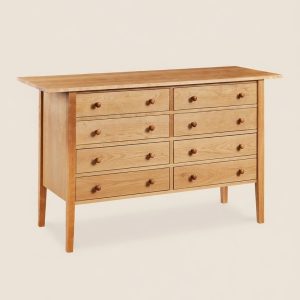
I sent Early American Life digital images of my furniture. There may have been a shot that showed dovetails, but there was no way to know whether my mortise and tenons were capable of reacting load. I was judged the way the world judges us all; based on the outward appearance of my work. I was judged based on my ability to execute an 18th c esthetic, or someone’s idea of an 18th c esthetic.
What people see when they look at our work isn’t how much wood we wasted or how tight our joints are. They see artwork. They respond to the color, shape, details, or hardware choice, all things we never talk about. Few of us have any experience or education to guide us in these matters. Yet we happily sift through woodworking articles in hopes of finding a few helpful tips. Are they tips about how to be successful as a woodworker? How to make things people will cherish and value? Some authors or magazines try and we disparagingly call them artsy fartsy and go back to Schwarz’ drill press review.
This year, I’m going to have a close look at what I think it means to make great stuff. And I’ll share with you how and exactly why I’m not One of America’s Best.
Adam