We may receive a commission when you use our affiliate links. However, this does not impact our recommendations.
I began woodworking in my thirties with the specific intention of making period reproductions. But I initially intended to “power up” my shop. When I started, I hadn’t made the connection between tools and final forms. I read the magazines and made a list of “required” tools. I think the tally was somewhere in the neighborhood of $10,000. I recall selecting a Jet cabinetsaw as the “heart” of my shop and a Delta dust collection system. I don’t know where I thought I was going to get the money. Not only didn’t I have the money, I didn’t have the floor space for half of the tools on my list. But I was not dissuaded.
Before purchasing the tools on my list, I took what would become a life changing decision; I decided to learn to work by hand before purchasing any power tools. Even then, it wasn’t a decision informed by “form follows process”. It was simply a decision to choose skill over consumerism. I didn’t want to buy my way into a craft so many members of my family had spent a lifetime mastering. It just didn’t feel right to me.
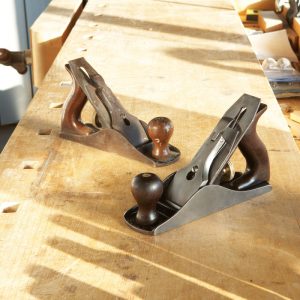
I bought an old stanley #4 and (being an engineer) set measurable goals. When I could plane a board flat, then I would have “earned” a surface planer. When I could saw true with a hand saw, then I would buy a table saw. When I could square an edge, then I would buy a jointer and so on. I figured the whole learning process would take about 6 months! (I was a little off.) As my skills increased, I starting crossing tools off my list. My hand tools were becoming what I felt were practical alternatives to the power tools on my list.
Years later, I got to use a table saw for the first time. By then, I had already become a proficient sawyer. I found the fence restrictive and annoying. The band saw seemed a better fit with the way I approached woodworking. I work by eye. I work to pencil lines or gauged lines. But I was surprised at how slow the tool cut. From my perspective, it was a little like sitting in traffic. Taking back roads may take just as long, but at least you’re doing something. Woodworking for me is an active process. Never do I stand watchfully and wait for something to happen. When I’m in a hurry, I can work harder, and stuff gets done faster.
I didn’t set out to become a hand tool guru. I wasn’t searching for a method of woodworking entirely different from Norm’s. It just happened. I like to think that I went where the tools and the period furniture I was reproducing led me. This is why we need to encourage our schools to offer shop classes (mine didn’t). Early exposure to large stationary woodworking machinery will stop kids from turning out like me. Do you want your son to look like this someday?