We may receive a commission when you use our affiliate links. However, this does not impact our recommendations.
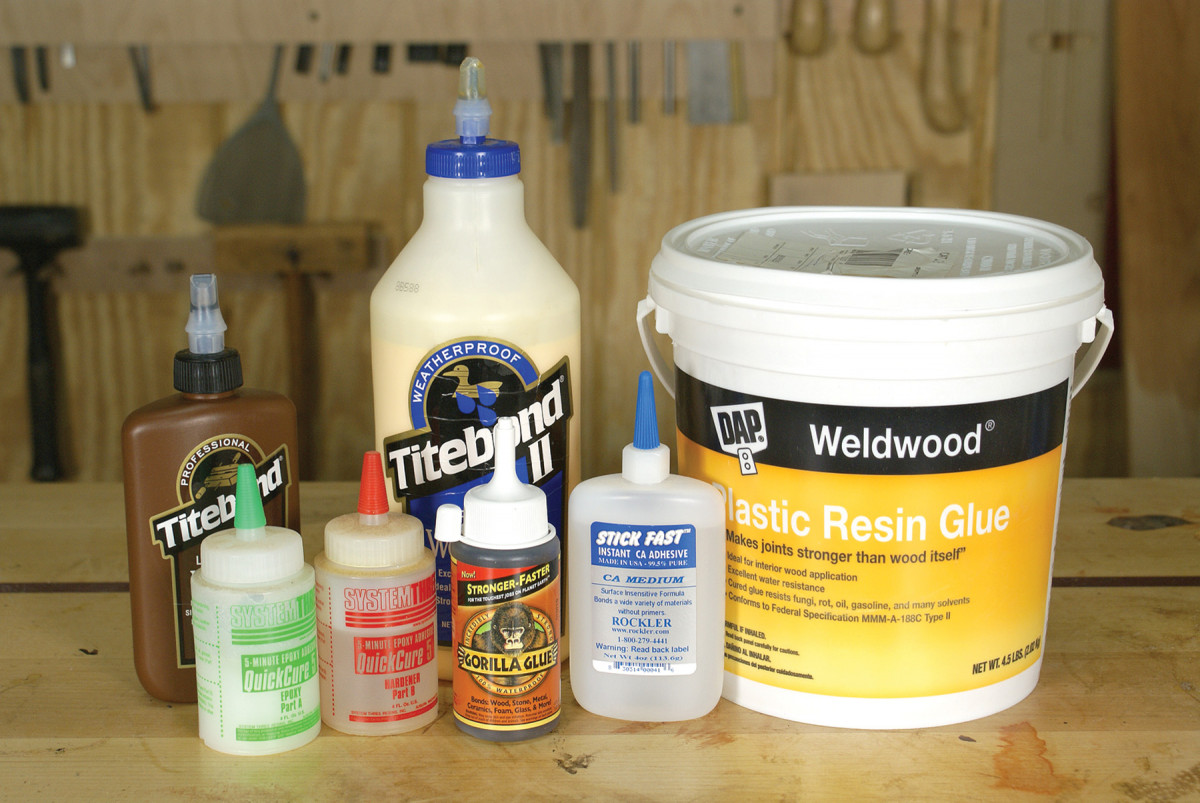
A glue for every reason. While woodworkers generally rely on yellow glue (polyvinyl acetate) for most glue jobs in the shop, depending on the task at hand, there might be a better choice available.
Six common situations where specialty glues serve you well.
It goes without saying that most of our projects would be nothing more than a loose assembly of parts without the holding power of glue. Thankfully, modern adhesives are accessible, usually inexpensive and keep us from having to mill wedged tenons for everything we build. Most woodworkers begin by using good old yellow glue (polyvinyl acetate or PVA). It’s a great general-purpose glue that serves me well for about 90 percent of my tasks. But there are a number of unique glues that work particularly well for specialized applications.
Online Extra: To view a video about how to use glue for veneering, click here.
Working With Veneer
Top choices: Dap Weldwood Plastic Resin Glue or Unibond800
Veneer requires two major things from glue – rigidity and a long open time. Sounds like a job for urea formaldehyde! There are two brands of urea formaldehyde that I use in my work. DAP’s Weldwood is a powder that you mix with water and Unibond800 is a liquid resin that is mixed with a powder activator.
Because of its water content, Weldwood is not ideal for veneering. By introducing water into the equation, both the veneer and the substrate swell. Then as the glue cures and the water evaporates, there could be open seams and cracks – that’s trouble. However, this same property is what makes it great for things such as bent lamination, where a little extra moisture helps the laminations flex.
For veneering, Unibond800 is my glue of choice. Of course, if you want to be a traditionalist, you can try hammer veneering with hide glue. But that’s a subject for another article.
Hurry Up – The Glue is Drying
Top choices: Dap Weldwood Plastic Resin Glue, Unibond800, or Slow-set Epoxy
It’s a common scenario. You’re gluing up a project and before you can get everything situated, the glue starts to dry. Panic sets in. You pull out your trusty dead-blow hammer and proceed to beat the daylights out of your latest masterpiece. Now unless you’re into distressed furniture, this is bad.
To avoid this situation, it’s a good idea to use glue with a longer open time. You should have enough time to assemble the parts, position your clamps and check to make sure each and every piece is positioned correctly.
Two of my favorite options are slow-set epoxy and just about any urea formaldehyde glue. Both give you up to 30 minutes of open time and that should be enough for just about any project, including those notoriously long bent-lamination clamping sessions.
So what are the downfalls? Epoxy and some varieties of urea formaldehyde can be pricey. And both should be handled carefully as they do contain harmful substances (refer to manufacturers’ instructions for details). These safety precautions are really just a minor detail and are well worth the time and effort for the extra open time you get in exchange.
Easy to Repair
Top choice: Hide Glue
When we build our projects, it’s important to think about their future – not necessarily next month or even next year. I’m talking 10 or more years from now. A chair, for example, with constant use, will almost certainly be in need of repair at some point in its lifetime. So it’s not a bad idea to use glue that facilitates easy repairs.
One of the best (and oldest) glues for this purpose is hide glue. Hide glue is made, as you might expect, from animal hides (and it smells like it, too). The great thing about this stuff is that it can be reactivated again and again over its lifetime. So if a joint becomes loose or a part needs to be replaced, the entire project can be taken apart and reassembled with the help of a little heat and moisture. In addition, hide glue binds very well to itself, so there is no need to completely remove the old glue from the joints.
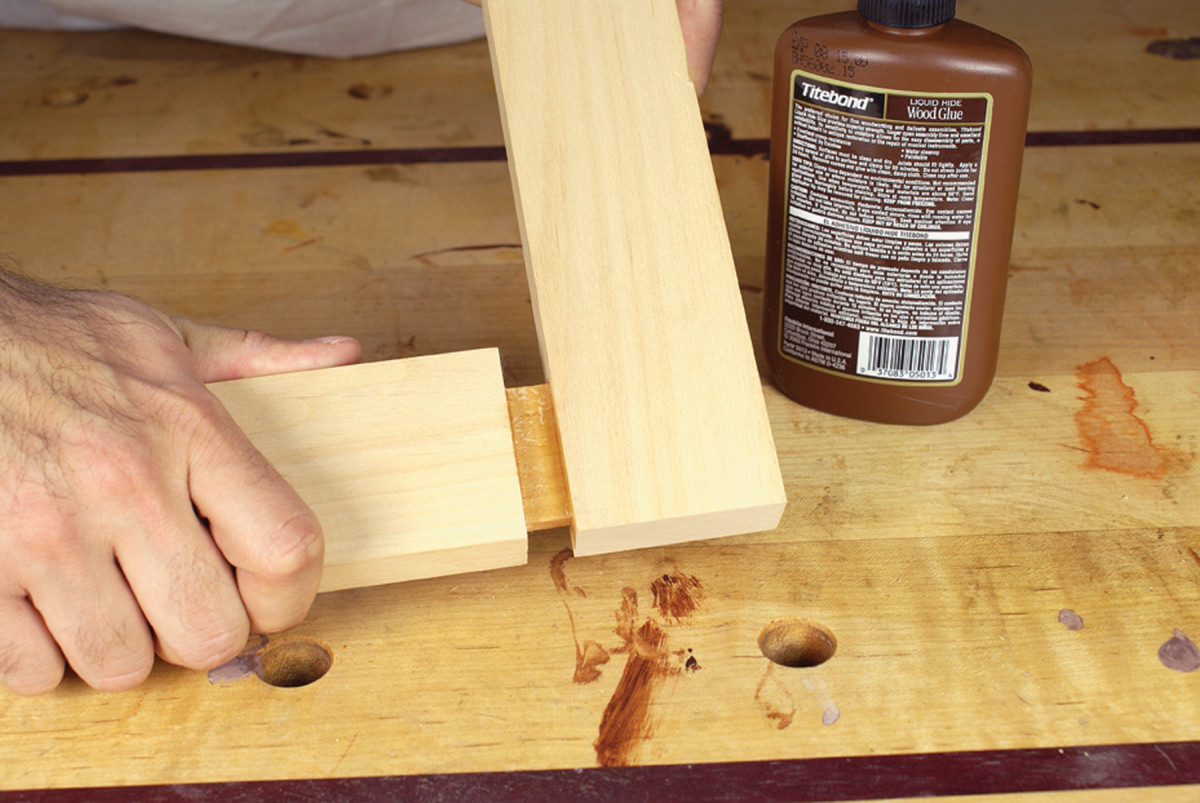
Best old glue. Hide glue is great for joints that are likely to need repair in the future.
Hide glue comes in two forms, a dry form that has to be mixed with water over heat, and a newer pre-mixed liquid variety that is ready to use. Many folks shy away from hot hide glue because it can be messy and time consuming. Fortunately, the pre-mixed liquid forms are now available and we have hide glue ready to go at a moment’s notice. Not only are these pre-mixed glues just as strong as their hot brethren, they are also competitive with the modern PVA glues that we know and love.
The Joint is Just a Bit Sloppy
Top choices: Dap Weldwood Plastic Resin Glue, Unibond800, or Epoxy
Despite your best effort, you will on occasion produce a joint that is just a bit too loose. To make the joint again is one option, but using gap-filling glue could very well save you a lot of time and effort. Remember though, not all glues have gap-filling abilities, and some are just downright terrible at it. (I’m talking to you, polyurethane glue!)
Glues such as epoxy and urea resin are my favorite glues for this task. Each is capable of filling occasional small gaps and making loose-fitting joints structurally sound.
Superficial Repairs
Top choices: CA Glue or Quick-set Epoxy
There are two glues that I turn to whenever I have to repair knots, digs, scratches or tear-out: cyanoacrylate (CA) glue and epoxy. CA glue, also known as Super Glue, is a fast-drying brittle glue that does a fine job of filling small holes and cracks as well as reattaching small pieces of wood that may have torn out. And if you have a little bubble in your veneer, CA glue is great for that, too. Just use a syringe to inject some glue under the veneer and clamp it down for a few minutes.
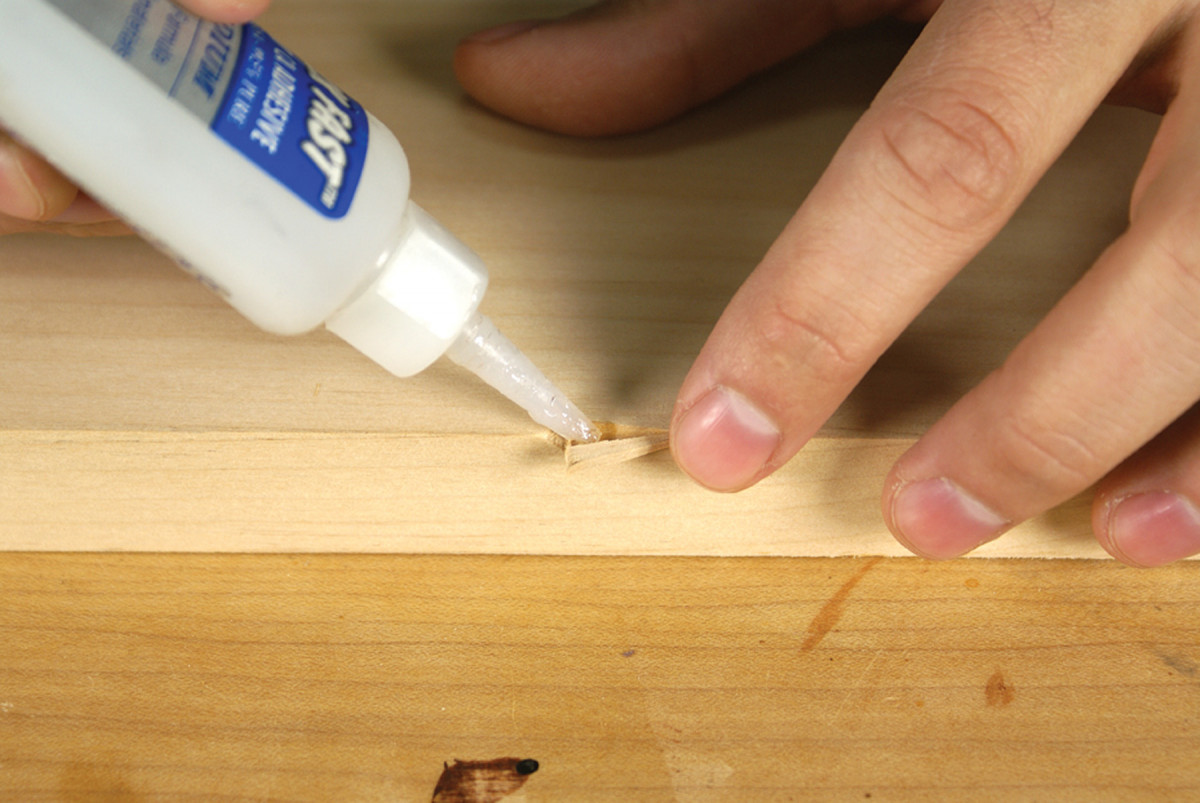
A quick fix. Accidental chip-out can be reattached in seconds with quick-drying CA glue.
If you’re really in a rush, like I usually am, pick up a can of quick-set activator. When sprayed over the CA glue, it instantly causes the glue to cure. Another great trick is to mix the glue with a little sawdust to serve as a color-matched filler.
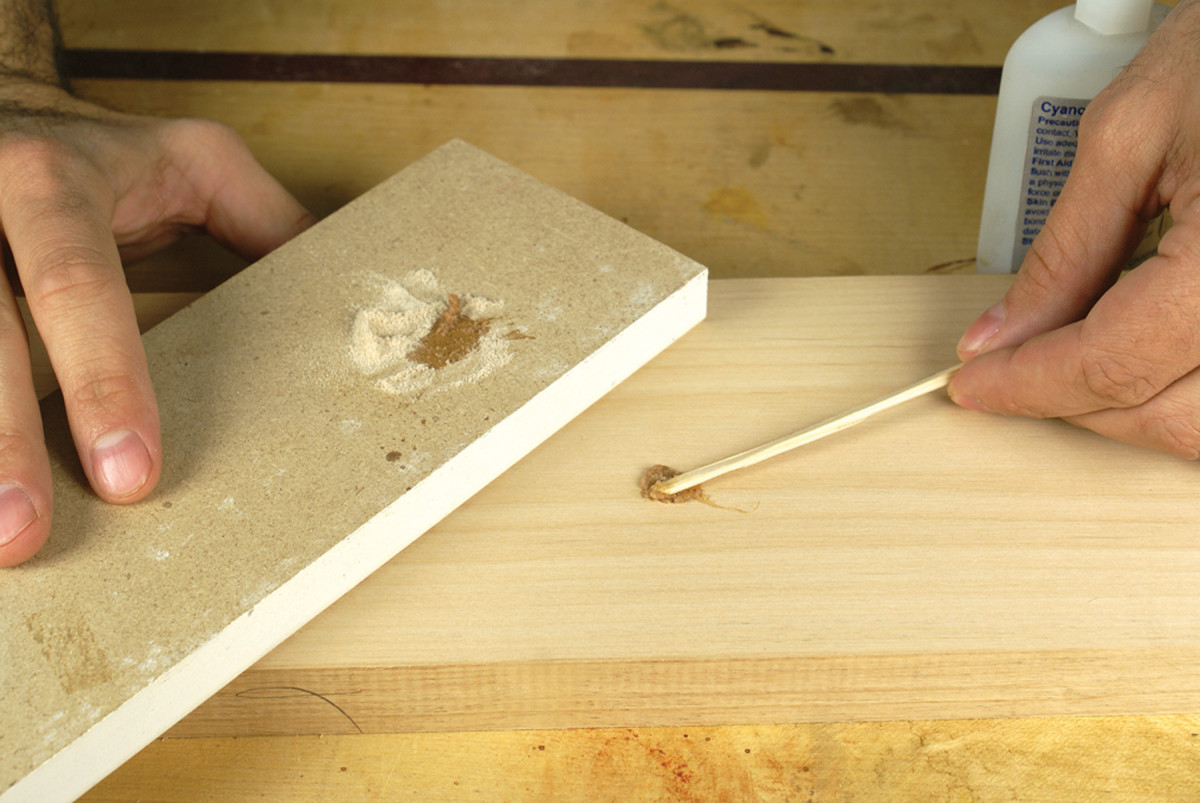
A fill-in filler. CA glue and sawdust make great homemade filler.
Epoxy, particularly the five-minute variety, is also great for quick repairs, but it does take a full five minutes to cure. I typically use it for filling holes and knots on horizontal surfaces. Its self-leveling nature and ability to take dye make it perfect for this type of thing. Aside from the dye, you can also add sawdust to the mixture to create nice homemade filler.
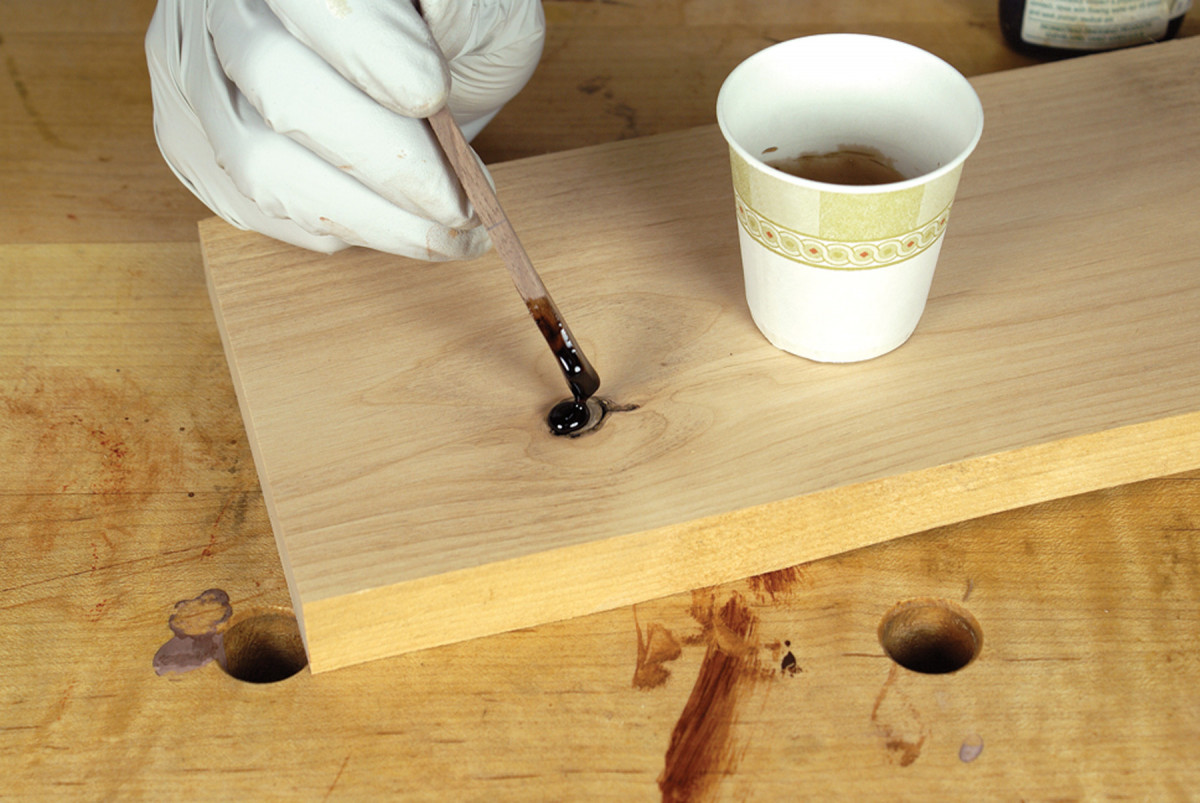
No longer loose. Stabilize knots and make them look natural with epoxy and dye.
Weatherproof Woodworking Glue Choices
Top choices: Type III PVA, Epoxy, Polyurethane, or Urea Formaldehyde
If you build any outdoor furniture, you should definitely be concerned with your choice of glue. Standard Type I PVA glue is not adequate for this task, as it has no water resistance. Fortunately, Type II PVA is water-resistant and Type III is waterproof. But there are other glues to consider as well, including epoxy, polyurethane and urea formaldehyde. These glues excel in their “water-proofness” and take just about anything Mother Nature can dish out. However, each of them has its own unique working properties, shelf life and usefulness in other projects, so you’ll have to decide which one best suits your needs.
These are just a few examples where specialized glues can get you out of a sticky situation. Of course, there are many other scenarios and numerous other glue options, but these are the ones that I rely on time and time again. I am sure they’ll work for you, too. Now, I realize that keeping all these different types of glue on hand at all times can be expensive and wasteful, so it’s good to know that our traditional PVA wood glues suffice for most woodshop tasks. But it’s like the old saying: It’s important to use the right tool for the job. And glue, after all, is nothing more than a tool in our woodworking bag of tricks.
Here are some supplies and tools we find essential in our everyday work around the shop. We may receive a commission from sales referred by our links; however, we have carefully selected these products for their usefulness and quality.