We may receive a commission when you use our affiliate links. However, this does not impact our recommendations.

Like any profession, woodworking has a lot of jargon specific to the craft. And no matter how simple the project, I always seem to run smack up against this issue when writing woodworking articles.
Case in point: I recently finished building a wall box for the I Can Do That story in our August issue. The project was easy , just a few boards cut to size and nailed together. So I thought writing about it would be easy, too. And for the most part, it was. But, when my story made the first round through the other editors for changes, Senior Editor Bob Lang pointed out that my terminology was a bit off.
I wrote, “cut the shelf to the final width.” But, because the grain of the wood in the shelf runs side to side between the two upright pieces, what I was really doing was cutting it to final length.
However, to the novice reader (read: me and the target group for the I Can Do That projects), this is confusing. That piece of wood runs across the width of the shelf in the finished project, so if I wrote, “cut it to final length,” I suspect a lot of readers might be scratching their heads and wondering what the heck I meant. Because I didn’t have enough room to go into an explanation in the story, I simply wrote around the problem (a time-honored tradition in journalism).
But now I feel guilty about perpetuating my ignorance on unsuspecting readers, so here’s a quick primer I lifted from one of Bob’s books, “Shop Drawings for Craftsman Furniture.”
“For individual parts, width is always the direction across the wood grain, and length is always the direction with the grain,” writes Bob. 
In the photo above, on the top piece you can see the grain running top to bottom…which is the length. The width runs across the long side, from left to right. So, the top piece is 2-1/2″ long and 26″ wide. The bottom piece, in which the grain runs left to right, is 21″ long and 2″ wide.
The orientation of the parts in the finished piece makes no difference when discussing the individual pieces.
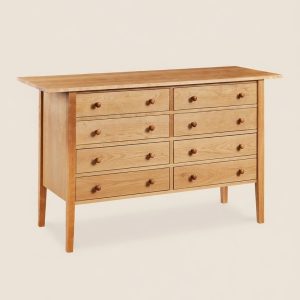
Once, however, the pieces are put together, the dimension tags for the individual pieces no longer apply. For example, the long grain of a drawer front (the length, in pieces), runs across the width of a drawer. Oy vey.
Then there’s nominal v. actual size when buying lumber. See the ICDT manual for an explanation of that bugbear.
And don’t get me started on rebates/rabbets, cramps/clamps, trenches/grooves…¦