We may receive a commission when you use our affiliate links. However, this does not impact our recommendations.

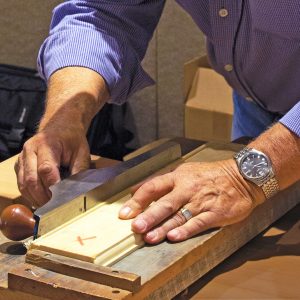
A close-up photo of the gearing on the Fenner Patent frame saw.
And you thought yesterday’s posts about Estonian workholding was obscure? Bah, that was amateur hour.
Let’s talk about the Charles Fenner Patent frame saw, a fairly rare bird among collectors. Usually “rare” means “didn’t work or sell too well.” But the Fenner is so wild that I had to try one out. The thing has gears, a chain drive and an awesome tensioning device. All it’s missing is a compass in its stock.
The idea behind the saw is that the chain-drive mechanism keeps the two ends of the blade parallel at all times, which is a nice thing for marquetry, according to the saw’s 1884 patent papers. (Read them here.) What isn’t so nice for marquetry is a saw with five points per inch. That’s a wee-bit coarse for thin materials.
If finally got my hands on a Fenner thanks to Carl Bilderback, my Midwestern tool pusher, carpenter and all-around nice guy. This week I finally got to play with the saw a bit and see what makes it tick.
The chain mechanism is surprisingly robust. The blade, however, was too dull to even execute an earthworm. So I sharpened it up, which is easier said than done. There’s only about 1/8” of meat beyond the gullet to clamp into a saw vise. Oh, and the blade was curved, so I had to clamp it in sections.
I put the blade in the saw and tensioned it up using the knob at the rear of the handle. The metalwork and turned handle of this saw is beautiful, much nicer than most modern stuff.
With the blade sharpened, the thing flew through 1” cherry and walnut. It actually didn’t much care for pine and got stuck several times. After fooling around with it for an hour I had Megan and Glen give it a try.
Check out the short video that shows me sawing, followed by Megan. A 5-point saw is a tricky beast to start and keep under control.
The Fenner is a beast, and I don’t think it will become a part of my tool kit – until I start making life-size unicorn puzzles.
— Christopher Schwarz