We may receive a commission when you use our affiliate links. However, this does not impact our recommendations.
 Perhaps the headline should read “the tool I hate to love.” Every now and then I need something round, or an odd-sized hole, and I turn to the “adjustable circle cutter.” I know it as a “fly cutter” and it is never my first choice. It’s a simple device, but it looks scary, and for good reasons. It can do some serious damage if you don’t follow the rules for using one safely. Here are my rules:
 Sharpen the cutter – these come with a decent grind on them, but a few strokes on the sharpening stones give a cleaner cut with less resistance.
- Make sure that all of the Allen screws are really, really tight – one of the nice things about this tool is that everything is adjustable; the radius of the knife and the depth of both the drill bit and the knife can be set.
- Double-check that all of the Allen screws are really, really tight – one of the bad things about this tool is that everything is adjustable. If one of those screws comes loose while the tool spinning around, things can go flying. Hence the term “fly cutter.”
- Run the drill press at the slowest possible speed. On our Powermatic that’s around 400 RPM, and I wish this machine could be set down around 250 RPM. I would feel better if it did.
- Clamp the work securely to the drill press table and don’t get your hands anywhere near the thing when it’s running. If something goes wrong, turn off the machine and duck under the table until the spinning stops.
- Feed the cutter into the work as slowly and gently as you can.

 In spite of the threatening nature of this tool, you can make precise, clean cuts with it when other tools let you down. I needed a band of ebony, about 1/8″ thick and 1/8″ wide to stick in a 4-1/4″-diameter slot. I wanted to use as little material as possible so I had six pieces mitered together and stuck down to a scrap of plywood.
My first thought was to use the same router that I used to make the slot, and different-sized guide collars with the same pattern I used to rout the slot. Attempt number one failed almost immediately when the pieces started coming off the substrate. Attempt number two failed very close to the end of the procedure. Making the final pass, the thin strips lifted off the bed and disappeared into thin air. A router bit generates a lot of force on a strip that thin, and there isn’t enough surface area for a removable adhesive to hold.
 I thought of using the lathe for “Plan B,” but I wanted a way to precisely set the diameters I needed. As I formulated a scheme for mounting the bank to the headstock and marking and making the cuts, I remembered the fly futter stuck in a drawer somewhere. On to “Plan C.”
The cutter is reversible, so you can set it for either a clean inside or outside cut. I cut the outside, then reversed the cutter and adjusted its position on the bar. Because the cutter comes to a sharp point, it can be set quite accurately. I was happy with the results, and regretted the hour or two I wasted trying to get the router to work.
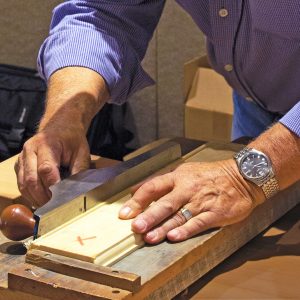
 At this point, you may be wondering why on earth someone would need an 1/8″-wide circular strip of ebony. The picture at left, of the ebony glued in place and trimmed flush is a clue – but you’ll need to read an “upcoming issue” of Popular Woodworking Magazine to get the whole story. If you’re a subscriber, don’t worry. If your not a subscriber, you can fix that by clicking on this link.