We may receive a commission when you use our affiliate links. However, this does not impact our recommendations.

As a presenter at woodworking schools, I enjoy teaching the methods I use when woodworking. For a recent class at the Marc Adams School of Woodworking, the subject was bracket feet, ogee bracket feet, and legs: cabriole and tapered. As the class begins, I ask attendees to ask questions because they are there to learn. While I’m there to instruct, one thing that almost always happens is that I pick up a trick or learn something from those who attend the classes. This class was no different.

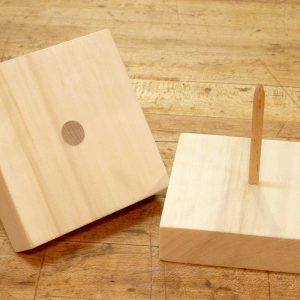
The class was moving along on schedule when I launched into my spiel on two methods to produce ogee bracket feet. I explained how to cove and shape the feet using a table saw , a method I used from the beginning due to my restricted band saw opening (a 14″ band saw without an extension has a 6″ capacity under the guide and wheel). I mentioned that after the feet are formed on the saw, spur holes drilled, profiled using a band saw then mitered, it was a bit more difficult to glue the pieces together due to the irregular shape (I often use duct tape as my clamps). However, if you assemble the two mitered blocks wherein the parts are easily glued and clamped, and you had a large enough clearance at your band saw to position the assembled pair on a stand, you can saw the profile very easily and the majority of the work is complete (The above setup is for demonstration only. The band saw blade is too wide to cut the needed profile). These are the two ways that I’ve made all the ogee feet I’ve used while woodworking.
A hand shot up to ask a question. “Why couldn’t you assemble the feet while square then create the profile at the table saw?” I stood there silently, trying to quickly work through the process to figure out why that could not be done. Nothing. I could not come up with a reason why that wouldn’t work. After a bit more conversation , which is a good thing in a class of woodworkers , we decided it could be done.
In a nutshell, here’s a third method to make ogee bracket feet: Cut your blanks to size and lay out the profile on the interior of each foot, drill out the holes that begin to form the spur (we decided that if you drill after you profile the face, you’re more apt to splinter the face as the bit plunges through the stock), miter the ends of the blanks remembering to keep the layout lines on the inside faces, cut for splines then assemble the feet into pairs as you install a spline. As you can see from the photo, the clamping process is much easier when assembling squared ends.

After the glue is dry, set up a fence as you would to create coves at the table saw (watch a video here). Raise the blade incrementally until you’ve reached the full height of your cove. Return to a band saw to complete the profile work then sand the ogee bracket feet before you attach them to your case.

Once again, I learned as I taught. This is what is great about woodworking. The more you know, the more you understand that there is plenty more to learn. No one method is correct, so keep your mind open and you may find a method of work that makes your woodworking better.
Other Resources on Traditional Furniture that We Recommend
– The Society of American Period Furniture Makers (SAPFM) (sapfm.org)
– “Building 18th Century American Furniture” (Popular Woodworking) by Glen D. Huey.
– “Making a Small Cove Moulding” video on the popularwoodworking.com web site.