We may receive a commission when you use our affiliate links. However, this does not impact our recommendations.

Roman workbenches have not left this world. In fact, some people might argue that they are still used today and are called shaving horses.
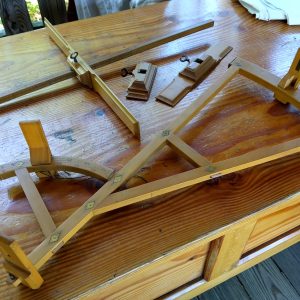
While I don’t have a dog in that particular fight, I do have some evidence to present on how they were used up through the 20th century in their original form: a thin plank with narrow legs tenoned into the plank.
The real story comes from a landmark book in hand-tool woodworking by A. Viires called “Woodworking in Estonia: Historical Survey” 1969. It’s a wonderful book with a strange history. It was copyrighted by the Israel Program for Scientific Translations Ltd. For the Smithsonian. While that all sounds nice and academic, it’s not.
While I still don’t have the full details on the history of the book, it appears it was translated and illegally published in the United States in 1969. Viires, the author of the Estonian book, says he had nothing to do with the translation. It was poorly done and was done against his will and wishes.
The book looks totally different in the original Estonian (I have a copy), but as I am still in Germany, I don’t have access to that copy. So I’ll have to use the Smithsonian version to talk about the Estonian-Roman woodworking connection.
Viires’ work, whether it was conscripted by foreign governments or not, is a remarkable glimpse into the pre-Industrial works in Estonia in the 20th century. It was a corner of the world where traditional skills and tools were still in daily use.

Of particular interest to me, of course, are the workbenches. These are low things that look unchanged since the Pompeii workbench shown in this blog entry.
Lots of people questioned whether the depictions of those benches is accurate. Are they really that low? That simple? With spindly legs?
I think the answer is “yes.” But I am happy to share some of the data I’ve collected during the last 10 years on the topic.
Here is an excerpt from Viires’ translated text that discusses the benches, how they were used and where they came from.
Use of the plane is connected with the use of a base upon which is to secure the object to be planed. For a long time a simple low bench, which was also used for all sorts of other woodwork, was used for that purpose. In some places this bench is to be found to this day (e.g., Avinurme), especially where woodwork as a home industry remains popular. The old bench, as we can see from models extant in Avinurme, has two holes at one end where the plank to be worked is secured against two inserted pegs. In doing so, the workman sits astride the bench, lending his weight to secure the board. In some benches only one peg is inserted. Long boards could be planed against the single peg with the planer sitting astride the board. There also used to be two holes in the middle of the bench, for use when the edges of the board were planed. Sometimes the bench had a square hole in the center for the inverted wedge when planing the side of a board.
Such simple benches were still in use among Russian home industry workers at the beginning of the present century. The urban cabinet maker also went on using them for a long time. Studying representations of Nurnburg cabinet makers from 1398 and 1444, it may be observed that identical benches were used. Only in German drawings of the 16th century do we see the appearance of higher and wider benches.


From Viires’ drawings and photos (sorry about the poor quality here), it’s clear that these benches were used for many tasks. And they weren’t braced against a wall or a post or anything else in particular. Instead, the stability, mass and pinching power came from a vise that is ultimately flexible and easy to acquire: the human body.
More details to come when I return home.
— Christopher Schwarz
If you like an historic approach to workbench design and construction, might I recommend the DVD “Build an 18th-century Workbench?” In it, I build a traditional French handtool workbench entirely by hand. With all the drawings, video and text you need to complete the project.