We may receive a commission when you use our affiliate links. However, this does not impact our recommendations.

Before

After
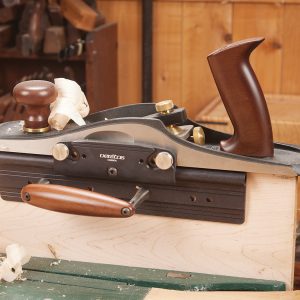
When setting up bench planes, the enemy is plane tracks – the ugly step created on a board when one (or both) of the corners of the tool’s cutter digs into your work.
In my opinion, plane tracks are uglier than tear-out, rotary-cut plywood and a Cincinnati Three-way.
There are lots of ways to avoid plane tracks. You can sharpen a slight camber in your cutter. You can sand out the plane tracks. You can do magic tricks. (Some woodworkers manage to use straight irons with good results.
– Ron Brese and Deneb Puchalski are two guys you can bug about this.)
Years ago, before I started cambering my irons, I merely filed the corners of the cutters so they were a small radius. This greatly reduced the chance that a corner would dig in.
I still file the corners of the irons for my bench planes. Here’s why: If the problem is caused by the corners, then remove the corners. Even with a cambered iron, the corners can dig in if the blade is set for a deep cut or it is not perfectly aligned in the mouth of your bench plane.
So if you file away the corner, the worst thing that can happen is that you will get some plane tracks with scalloped edges. And that looks much better than the sharp arris caused by an unfiled corner.
It takes just a minute to do. Here’s how it works.
Before you hone the iron, place it on a work surface – I usually use a scrap of wood. Place the iron so the bevel is facing down.
Get a file, almost any file. I use a mill bastard or a Multicut file because that is what is in my drawer.
With one hand, press the iron down. With the other hand, hold the file on its edge and against the side of the iron. Push the file forward and swing it around the corner of the iron until it is parallel to the edge of the tool. Do this a few times until the corner looks radiused.
This will bring up a burr on both the bevel and the face of the iron (which is why you do this before honing).
Switch hands and repeat the process for the other corner. Then hone the iron.
The short movie below shows what the hand motions look like. You can also do this process on a disc sander or belt sander. But a file is less likely to mangle you.
— Christopher Schwarz
Other Sharpening Stuff
• Do you have Ron Hock’s new book “The Perfect Edge” yet? You should. Ron has taken an esoteric topic and transformed it into some thing that is fun to read. Everyone needs a book on sharpening. And this is a very good one.
• Another excellent sharpening resource is Ian Kirby’s DVD “Sharpening Planes & Chisels.” Check it out here.
• For sharpening equipment, you should check out the site SharpeningSupplies.com. The company has a wide range of goods for every kind of sharpener.
• Having trouble sharpening scrapers? Check out this free story I wrote on our web site.
Here are some supplies and tools we find essential in our everyday work around the shop. We may receive a commission from sales referred by our links; however, we have carefully selected these products for their usefulness and quality.